
.svg)
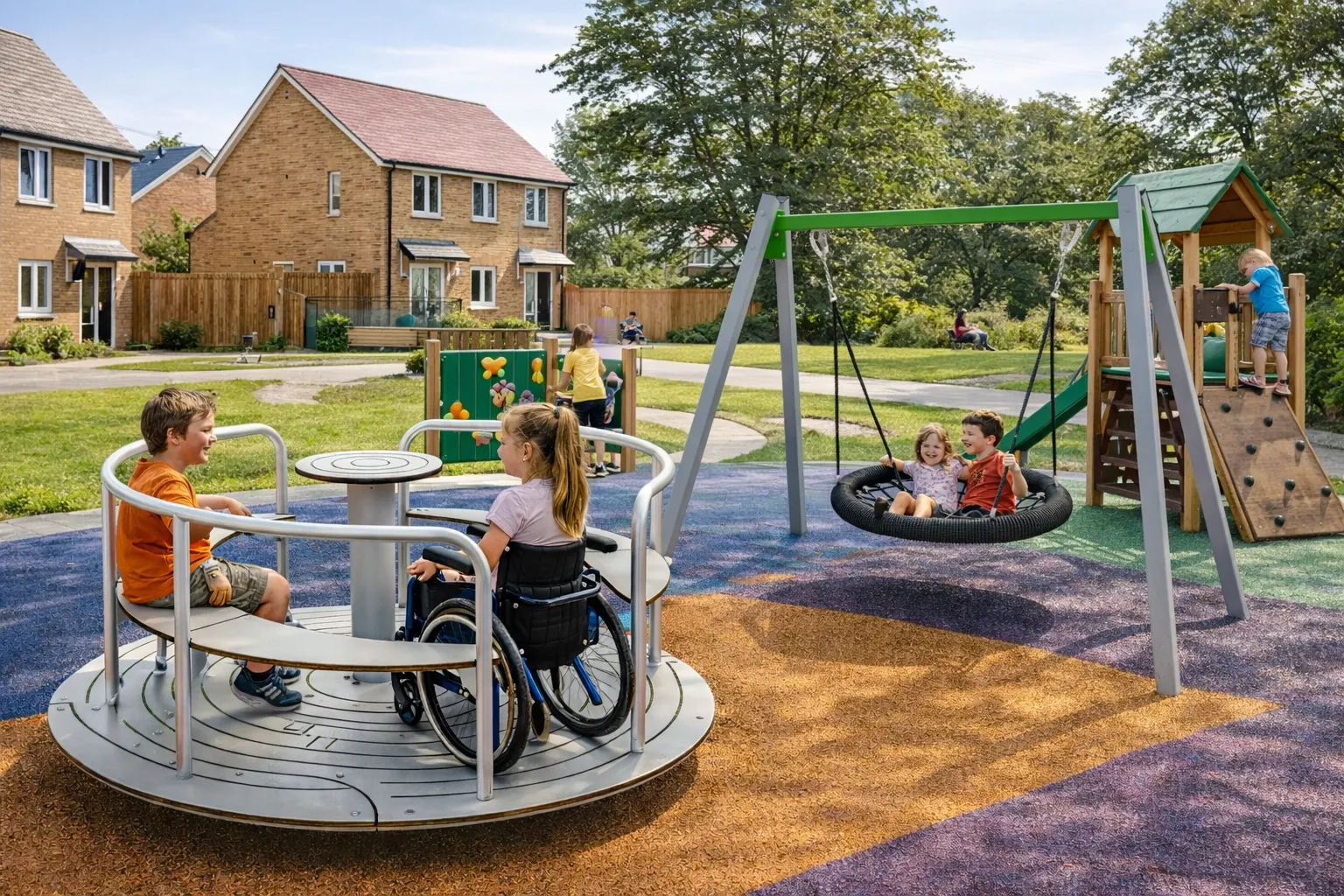


Inclusive Play in Housing Developments: Designing for All Abilities (UK)
Modern housing developments are no longer judged solely on the number of homes delivered. Increasingly, planners, local authorities and residents expect high-quality public spaces that support wellbeing, inclusion and community life.
Inclusive playground design plays a central role in this.
For developers, delivering inclusive play spaces is not only a planning requirement in many authorities — it is also a powerful way to create attractive, future-proof neighbourhoods that work for families of all abilities.
This guide explains how inclusive play should be approached in housing developments, what planners expect, and how developers can deliver accessible, commercially viable play environments that integrate seamlessly into wider schemes.
Why Inclusive Play Matters in Residential Developments
New housing communities bring together families with a wide range of needs, ages and abilities. Traditional playgrounds designed around single-use equipment often exclude children with mobility, sensory or cognitive impairments.
Inclusive playgrounds aim to:
- Allow children of different abilities to play together
- Remove physical and social barriers to participation
- Support sensory, social and imaginative play
- Create spaces that feel welcoming for all families
From a development perspective, inclusive play spaces:
- Strengthen planning compliance
- Support Section 106 and CIL obligations
- Improve market appeal to families
- Enhance long-term community satisfaction
- Reduce retrofit costs later
Well-designed inclusive play environments are now seen as an essential part of sustainable placemaking.
Inclusive Design Principles for Housing Play Areas
Inclusive play is not about installing a single accessible item — it is about designing the entire environment so that all children can participate naturally.
Key principles include:
Step-Free Access and Circulation
- Level entry routes from paths and pavements
- Firm, stable surfacing suitable for wheelchairs and pushchairs
- Wide circulation routes between equipment
Ground-Level Play Opportunities
- Interactive panels
- Sensory play features
- Low-level activity elements
- Social seating and gathering points
These ensure children with limited mobility can engage meaningfully with the space.
Multi-Ability Equipment Selection
Inclusive housing playgrounds typically include:
- Basket swings and supported swings
- Inclusive roundabouts and spinners
- Low-entry climbing and balance equipment
- Sensory and tactile play features
This approach supports shared play rather than segregated zones.
Developers planning inclusive residential play spaces may benefit from exploring SEN & Inclusive Playground Equipment to understand how shared-use equipment supports mixed-ability communities.
Planning Expectations and Local Authority Policy
Many local authorities now include inclusive play requirements within:
- Open space policies
- Residential design guides
- Section 106 agreements
- Public realm standards
Typical expectations include:
- Minimum proportions of accessible play features
- Step-free routes through play zones
- Clear sightlines and supervision
- Integration with wider green infrastructure
Inclusive provision is often reviewed during:
- Outline and reserved matters applications
- Discharge of planning conditions
- Adoption inspections
Early engagement with play specialists helps developers avoid redesign costs and delays later in the process.
Designing for SEN and Disability Needs in Residential Schemes
Inclusive housing playgrounds should accommodate a wide range of needs, including:
Physical Disabilities
- Wheelchair-accessible routes and equipment
- Transfer platforms and handrails
- Stable surfacing and edge protection
Sensory Needs
- Quiet zones away from busy equipment
- Tactile surfaces and sound features
- Natural elements for calming play
Neurodiverse Users
- Clear layouts and visual cues
- Predictable movement paths
- Reduced visual and auditory overload
For developments serving larger communities, integrating elements from Disability Playground Equipment can significantly improve usability for residents with long-term mobility needs.
Inclusive Play as a Commercial Asset
From a developer perspective, inclusive play delivers tangible commercial value:
- Stronger planning officer support
- Improved scheme reputation
- Higher appeal to family buyers and tenants
- Reduced future modification costs
- Enhanced ESG and social value reporting
Well-designed inclusive play areas also:
- Reduce conflict between age groups
- Improve community ownership
- Lower long-term maintenance risk
This aligns directly with long-term asset management strategies for managing agents and estate operators.
Integration with Wider Residential Masterplans
Inclusive playgrounds should not feel like bolt-on features.
Best practice integration includes:
- Locating play near pedestrian routes and green corridors
- Linking to walking and cycling networks
- Providing seating and social spaces for carers
- Ensuring passive surveillance from surrounding homes
Inclusive play works best when it forms part of a coherent public realm strategy rather than a standalone fenced zone.
Developers planning large or phased schemes may also benefit from reviewing Phased Playground Delivery for Large Housing Developments (UK) to ensure inclusive provision is delivered at the right stages of build-out.
Compliance, Safety and Long-Term Performance
All inclusive playground equipment must comply with:
- EN 1176 playground equipment standards
- EN 1177 surfacing requirements
- Local authority adoption criteria where applicable
Beyond compliance, developers should consider:
- Whole-life maintenance costs
- Durability for high-use residential settings
- Ease of inspection and repair
- Replacement planning
Inclusive equipment is now available in highly robust formats suitable for adopted and private estate environments.
Creating Communities That Work for Everyone
Inclusive play is not only about meeting regulation — it is about building places where all children feel welcome, valued and able to participate.
In housing developments, this delivers:
- Stronger community identity
- Improved wellbeing outcomes
- Better long-term placemaking results
- More sustainable, resilient neighbourhoods
Developments that invest properly in inclusive play consistently outperform those that treat it as a minimum compliance item.
Speak to Housing Playground Specialists
If you are planning a residential development and want to deliver inclusive, compliant and commercially robust play environments, our team can support you from early planning through to installation.
We regularly work with developers, planning consultants and managing agents across the UK to design inclusive housing playgrounds that integrate seamlessly into modern residential schemes.
Contact Morti Sport & Play to discuss inclusive playground design for your housing development.


