.svg)
Inclusive & SEN Playgrounds: Design, Equipment & Installation | UK
Creating outdoor spaces where every child can play — inclusive playground design and installation for schools, councils, developers and architects across the UK.
What Is an Inclusive Playground?
An inclusive playground is one designed so that children of all abilities — including those with physical disabilities, sensory impairments, cognitive and learning difficulties, and neurodivergent conditions such as autism and ADHD — can access, enjoy and engage with the space alongside their peers.
True inclusion is not about segregated areas for disabled children and a separate zone for everyone else. It is about designing a single, coherent space that offers multiple ways to engage, appropriate challenge at different levels, accessible routes throughout, and equipment that welcomes both independent use and supported play.
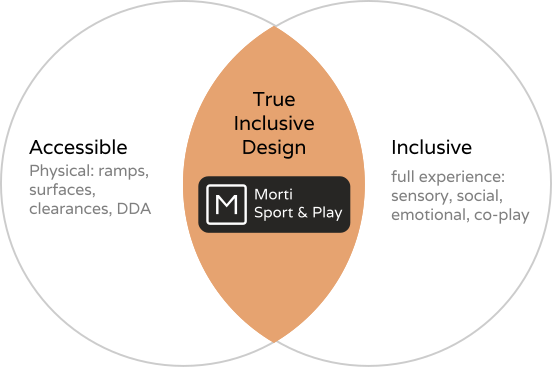
An inclusive playground is different from an accessible playground, though the two overlap. Accessibility addresses physical access — ramps, surfaces, clearances. Inclusion addresses the full play experience: sensory engagement, social opportunity, emotional safety, and the chance for all children to play together rather than side by side.
Morti Sport & Play designs inclusive playgrounds for mainstream schools, SEN schools, public parks, council estates, housing developments and EYFS settings across the UK.
Why Inclusive Play Matters
The case for inclusive play is developmental, legal, and social. Here is why it matters for every site.

For children
Play is how children develop physically, emotionally, socially and cognitively. For disabled children and those with SEN, inclusive outdoor play is especially important: it builds motor skills and strength, reduces anxiety, improves sensory processing, and provides the social contact that builds friendships and communication skills. Research published in the Journal of Autism and Developmental Disorders shows that sensory play interventions improve sensory processing abilities in children with ASD. Children who feel excluded from play spaces miss all of this — and the impact follows them into the classroom.

For schools & councils
For schools, inclusive provision is not optional — it is a legal duty under the Equality Act 2010. For councils, the Public Sector Equality Duty requires active promotion of disability equality. For both, an inaccessible playground creates legal exposure, Ofsted risk, and reputational damage. An inclusive playground removes that risk and demonstrates your commitment to every child in your community.

For communities
Inclusive playgrounds are better playgrounds for everyone. Wide ramps and level surfaces benefit pushchair users, older visitors and anyone with a temporary mobility need. Sensory features engage children of all abilities. Equipment that allows social play between children of different abilities builds empathy and community connection from an early age. The investment in inclusive design pays dividends for every person who uses the space.
The Legal Framework: What UK Law Requires
Inclusive play provision is not a nice-to-have in the UK — it is underpinned by law. Here is what the legislation means for your project.
Equality Act 2010 (all sectors)
Under the Equality Act 2010, it is unlawful for any school, council or public body to discriminate against a child on grounds of disability. The duty to make reasonable adjustments is anticipatory — organisations must consider in advance how to ensure disabled children can access and participate in all activities, including outdoor play. Failure to provide accessible and inclusive play provision can constitute disability discrimination. This applies to all maintained schools, academies, free schools, councils, housing associations and public open space operators.
Public Sector Equality Duty (councils & LAs)
Under section 149 of the Equality Act, all public bodies — including local authorities — must actively eliminate discrimination, advance equality of opportunity, and foster good relations between disabled and non-disabled people. For councils managing play areas, this is not satisfied by compliance alone: it requires active consideration of how play provision serves disabled residents and their families. A PiPA-aligned design process provides demonstrable evidence of meeting this duty.
Children and Families Act 2014 (schools & MATs)
The Children and Families Act 2014 establishes the framework for children and young people with Special Educational Needs and Disabilities (SEND) from birth to 25. It reinforces the presumption of mainstream education and requires schools to use their best endeavours to ensure children with SEN receive appropriate support. For school playgrounds, this means play spaces must not become a barrier to the inclusive participation the Act is designed to secure. Schools must also maintain an Accessibility Plan, which should address outdoor play provision.
Section 106 / Planning Obligations (developers)
Under the Town and Country Planning Act 1990 (Section 106), developers of residential schemes above certain thresholds are required to make planning obligations — including the provision of public open space and play areas — as a condition of consent. Local authority planning policies increasingly require these play areas to meet accessibility and inclusive design standards. Developers who can demonstrate inclusive play provision from the outset avoid costly conditions and re-design at planning discharge stage.
BS EN 1176 + CEN/TR 16467 (all sectors — equipment standard)
BS EN 1176 is the British and European standard for playground equipment safety. It applies to all commercially installed play equipment in the UK. The supplementary technical report CEN/TR 16467:2013 — Playground Equipment Accessible for All Children — provides additional guidance on inclusive design within the BS EN 1176 framework. Morti supplies equipment certified to BS EN 1176. There is no separate legal standard specifically for inclusive playgrounds, which means the PiPA Accreditation (see S10) provides the most recognised benchmark for design quality.
Inclusive Play vs SEN Playgrounds: Understanding the Difference
These terms are often used interchangeably but they describe different — though overlapping — design approaches. Understanding the difference helps you specify the right solution for your site.
Inclusive design means designing for the full spectrum of ability from the outset, so that all children can use the same equipment and spaces together. It is universal design applied to play. An inclusive playground does not have a 'disabled section' — it has equipment and layout that works for everyone.
SEN-specific design goes further for schools and settings that serve children with particular educational, sensory or physical needs. A SEN playground is still inclusive, but it may also include dedicated sensory zones, self-regulation spaces, visual timetabling panels, low-stimulation retreat areas, and equipment calibrated to specific therapeutic outcomes — vestibular input, proprioceptive feedback, fine motor skill development.
Inclusive design is the goal. Every child should be able to engage with every part of the playground.
SEN-specific design goes beyond inclusive. The space must be structured, predictable, sensory-rich and therapeutic.
Inclusive design is the standard. PiPA accreditation is the benchmark.
Inclusive design is required by planning policy. Equipment must be accessible to all residents regardless of ability.
Both approaches share a design methodology — universal design principles applied from concept, not retrofitted at the end.
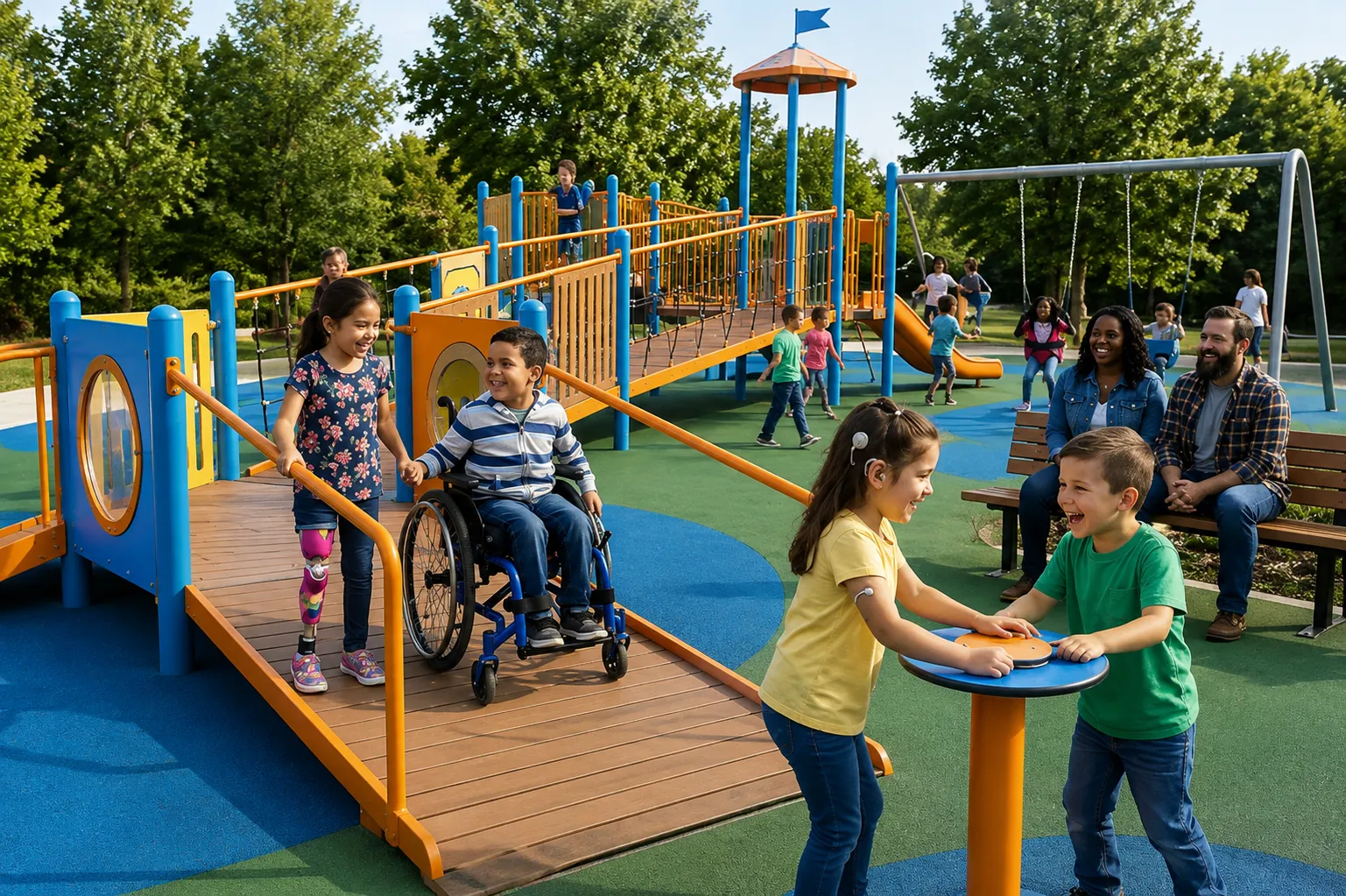
Inclusive & SEN Playground Equipment
Morti supplies the full range of inclusive playground equipment — from wheelchair-accessible swings and ramp-access towers to sensory play tables and musical instruments. Every product is certified to BS EN 1176 and can be specified within a PiPA-aligned design process. The table below shows each equipment category, key Morti products, best-fit sectors, and design notes.
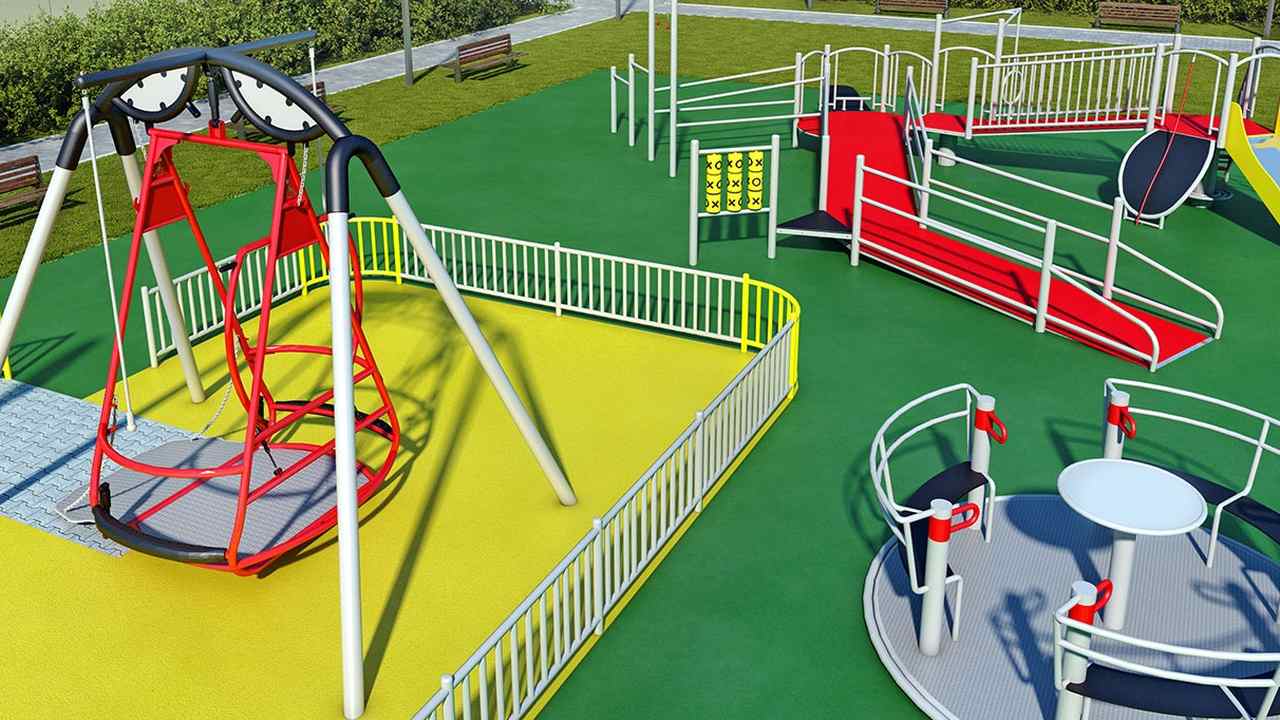
Multi-Activity Inclusive Systems
Key Morti Products
Inclusive Stainless Steel Multi-Activity Play Set (Snail); Inclusive Stainless Steel Play Unit (Sensory Bridge); Inclusive Stainless Steel Multi-Activity System (Sand Play)
Best For (Sectors)
SEN Schools; MATs; Larger Council Parks
Design Notes
Full-system specifications: approach paths, use zones, surfacing and sightlines must be designed as one. Specify PiPA checklist compliance.
.webp)
Robinia Timber Inclusive Structures
Key Morti Products
Accessible Robinia Hardwood Wheelchair Play Structure; Inclusive Swing with Supportive Seat (Robinia); Robinia Pendulum Inclusive Swing
Best For (Sectors)
Nature-play Schools; Community Parks; Rural Councils
Design Notes
Robinia requires no preservative treatment. Natural aesthetic preferred by biodiversity net gain schemes and nature-play approaches.
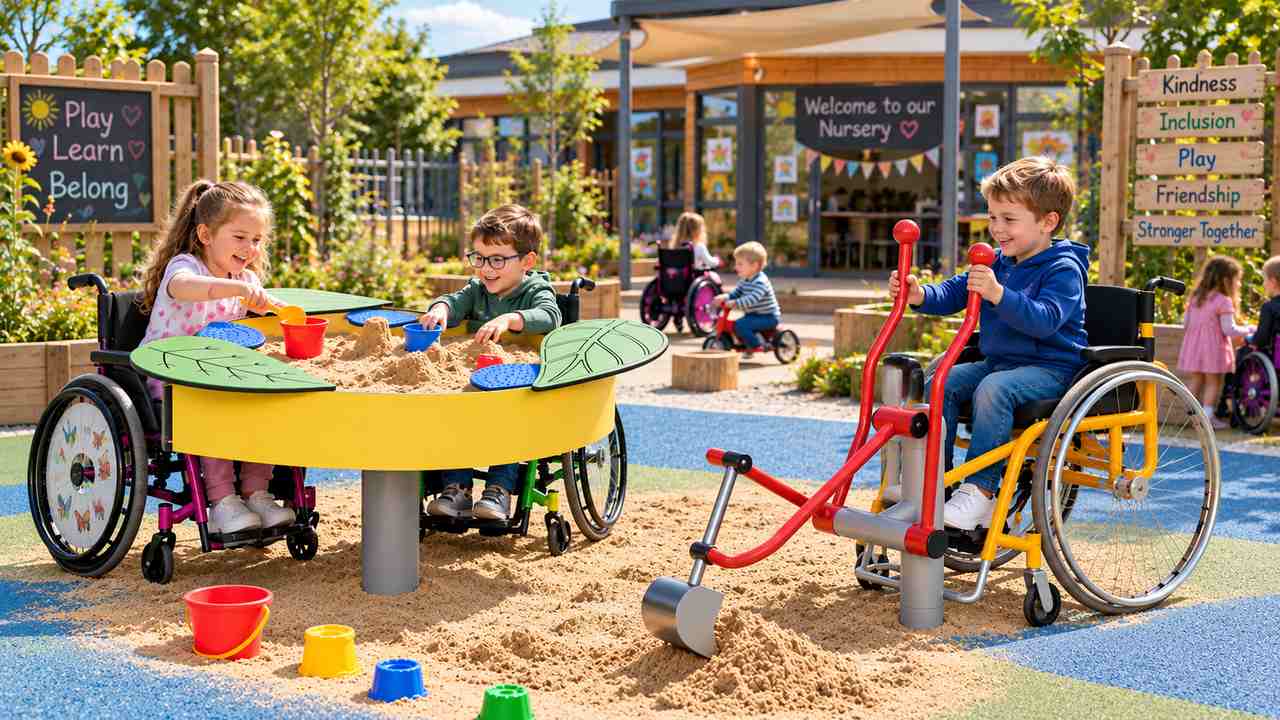
Sand & Water Play
Key Morti Products
Inclusive Wheelchair-Accessible Sand Play Table; Inclusive Wheelchair-Accessible Sand Digger; Sand and Water Play Table
Best For (Sectors)
EYFS; SEN Primary; Housing S106
Design Notes
Table height for wheelchair approach — specify 700mm clearance underneath. Co-play design allows standing and seated users simultaneously.
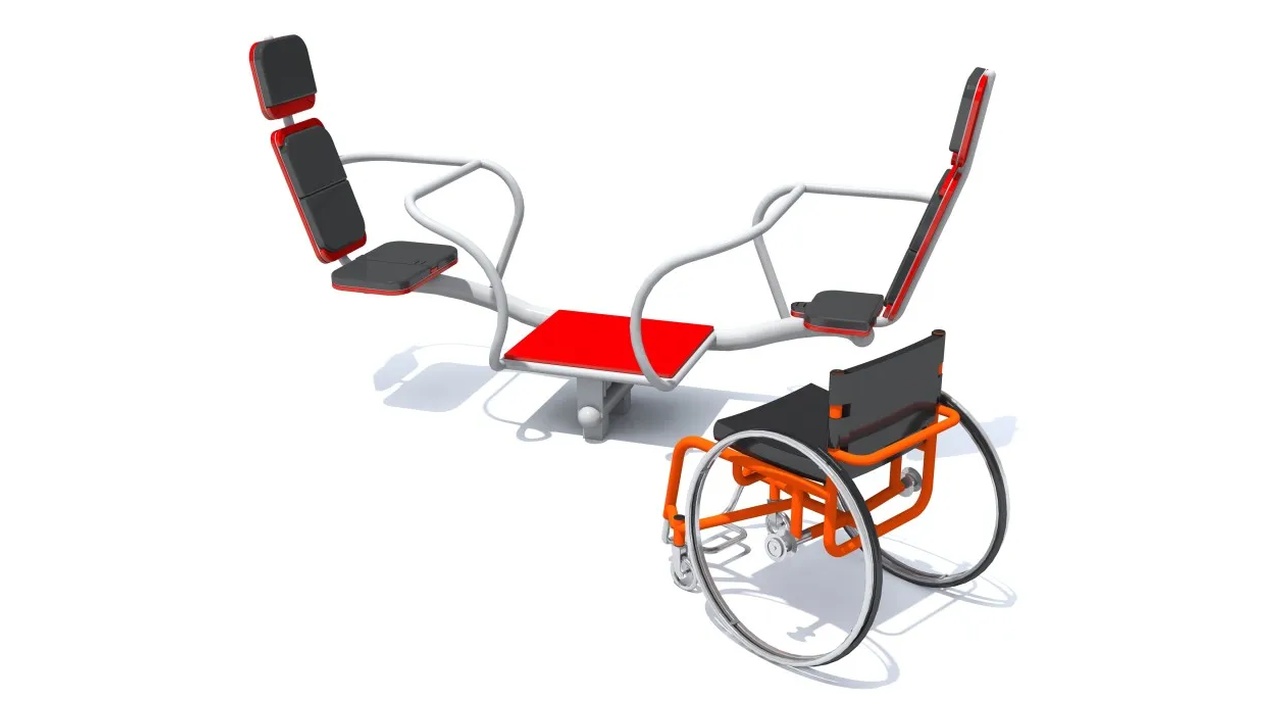
Seesaws & Rockers
Key Morti Products
Inclusive Three-User Seesaw; Inclusive Wheelchair Rocker; Inclusive Wheelchair-Accessible Platform Rocker (spring)
Best For (Sectors)
SEN Schools; Community Parks
Design Notes
Specify platform rockers where wheelchair users cannot transfer. Multi-user seesaws allow mixed-ability play alongside peers.
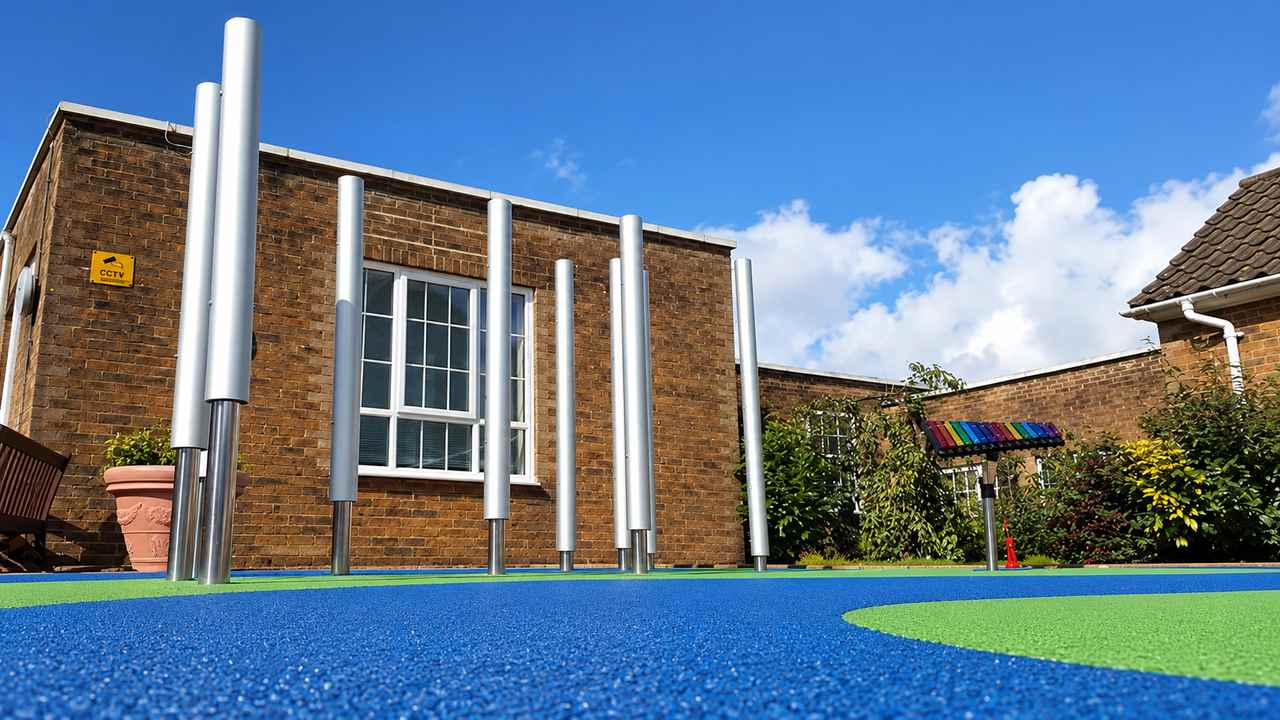
Sensory & Musical Play
Key Morti Products
Inclusive Stainless Steel Musical Play Set; Inclusive Creative Play Table with Light-Up Rotating Wheels; Sand & Water Play Table
Best For (Sectors)
SEN Schools; Councils; EYFS/Housing
Design Notes
Ground-level access essential. Musical elements support ASD and sensory processing needs. Wheelchair approach clearance min 900mm.
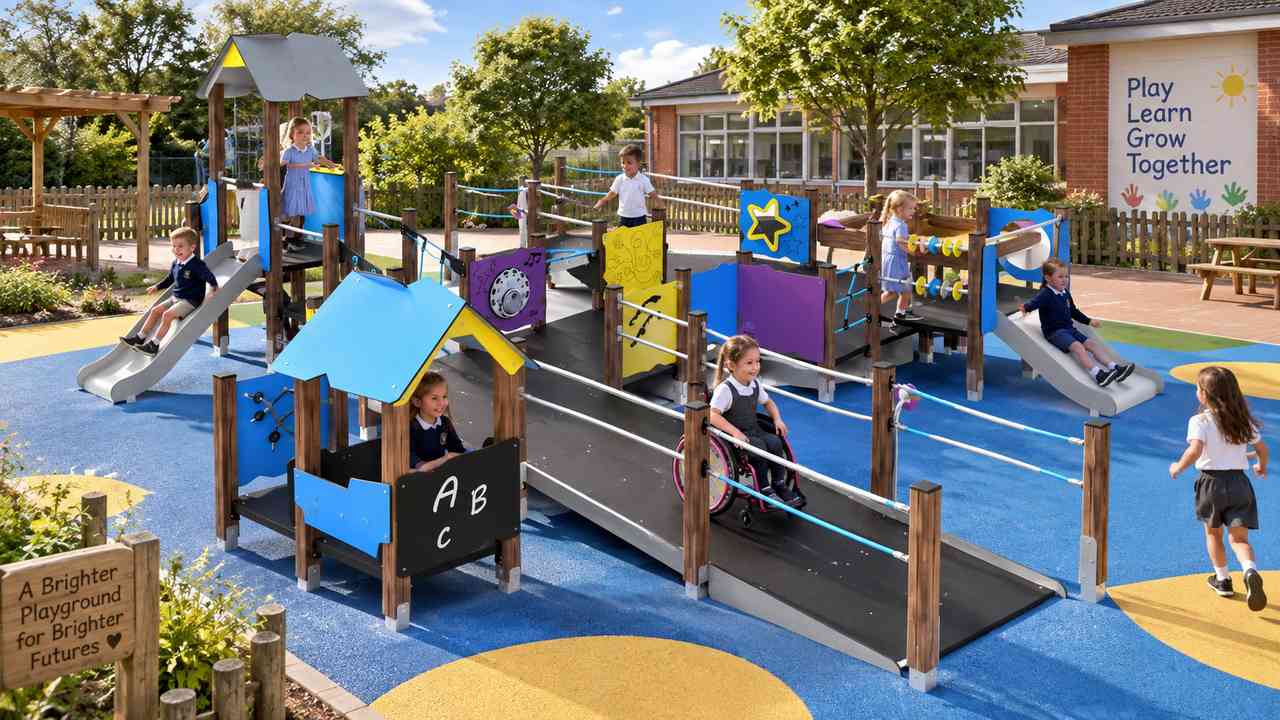
Ramp-Access Play Towers
Key Morti Products
Inclusive Ramp-Accessible Play Tower; Inclusive Ramp-Accessible Play Tower with Sensory Panels; Inclusive Steel Ramp & Climbing System with Tunnels
Best For (Sectors)
Schools (primary, SEN); Councils & Parks; MATs
Design Notes
Ramp gradient must comply with DDA intent. Specify contrasting colour edges. Sensory panel integration on tower landings.
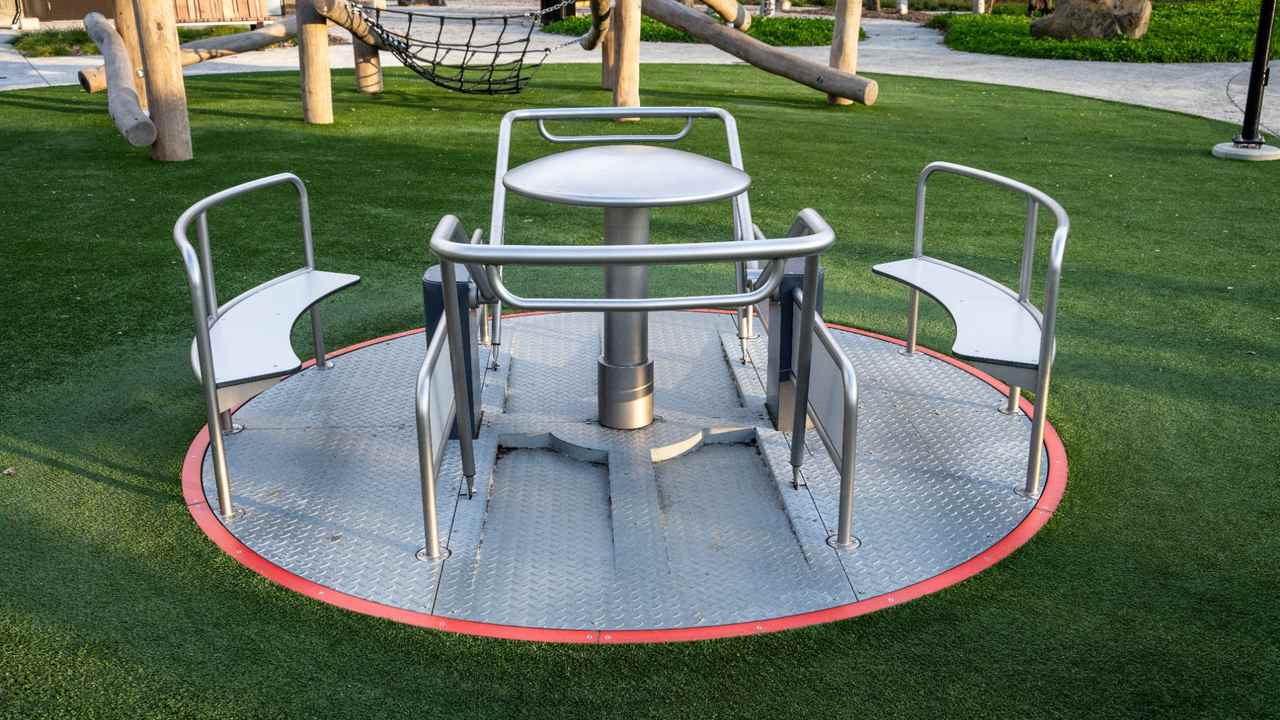
Wheelchair Roundabouts & Carousels
Key Morti Products
6-Seater Wheelchair Accessible Roundabout; Double Wheelchair Roundabout; Inclusive Wheelchair Accessible Roundabout with Integrated Seating; LED Sensory Roundabout
Best For (Sectors)
Councils & Parks; Schools; Housing S106
Design Notes
LED sensory option adds neurodiversity value. Specify flush approach paths from wetpour surfacing.
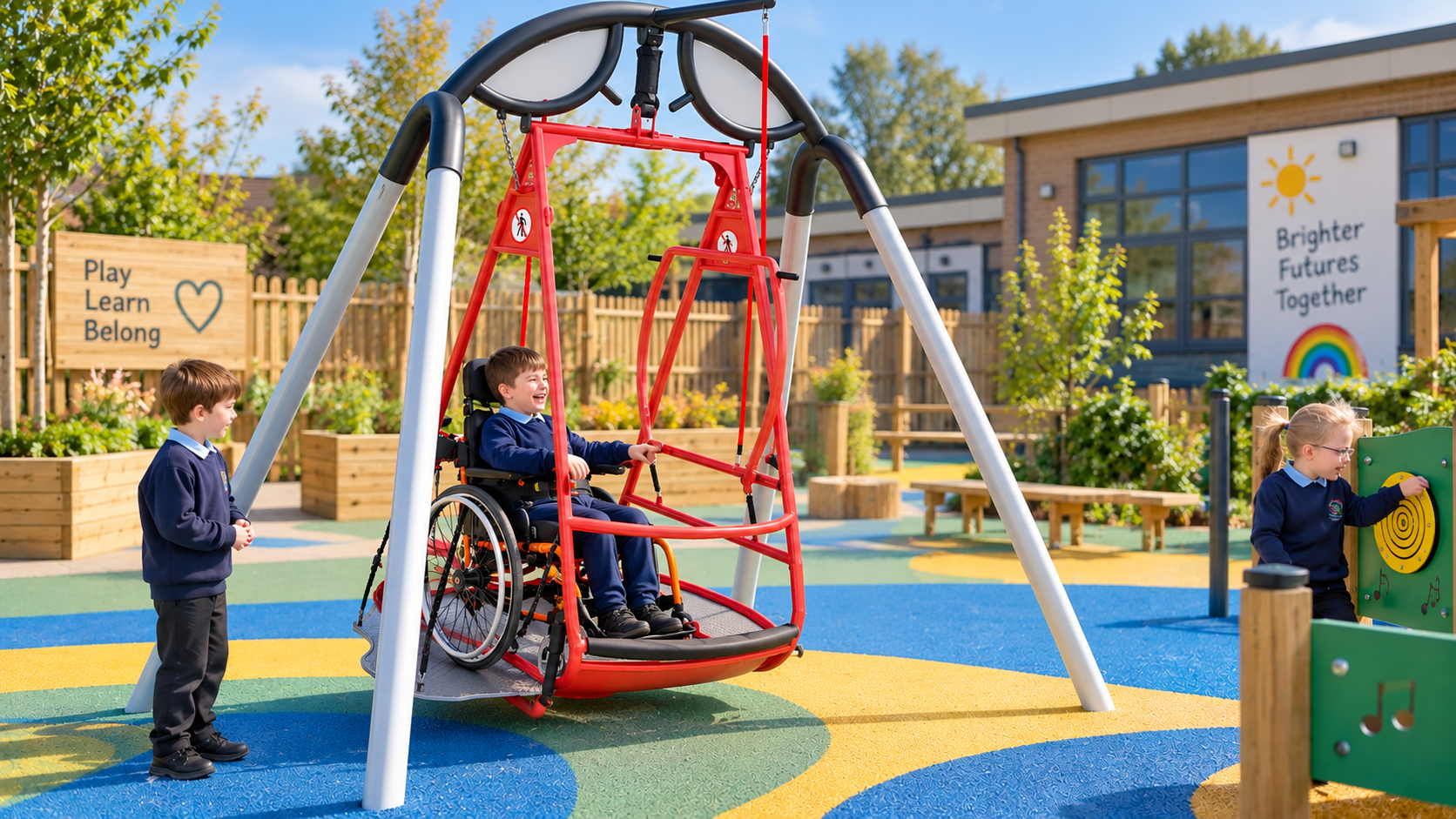
Wheelchair-Accessible Swings
Key Morti Products
Large Wheelchair Accessible Swing (electric WC); Inclusive Supported Seat Swing; Inclusive Supported Basket Swing; Basket Swing with Butterfly Panels
Best For (Sectors)
All sectors — the single most-requested inclusive item
Design Notes
Ensure wide enough bay spacing for carer assist. Specify basket and flat seat options on same frame for mixed-ability use.
.webp)
Designing for Neurodiversity: Autism, ADHD & Sensory Processing
Inclusive play increasingly means designing for neurodiversity — not just physical access. Children with autism spectrum disorder (ASD), ADHD and sensory processing differences have specific needs that can be addressed through thoughtful equipment selection and playground layout.
Why it matters
In England, approximately 1 in 5 children has some form of SEND. Around 1 in 100 children is autistic. Many children with ADHD and autism have sensory processing differences that make conventional playgrounds overwhelming, confusing or simply unusable without design modifications. Research published in the Journal of Autism and Developmental Disorders shows that sensory play interventions improve sensory processing abilities and reduce sensory-related challenges in children with ASD. Designing for neurodiversity is therefore not a niche requirement — it affects a significant proportion of children in every school and community.
Design principles for autism
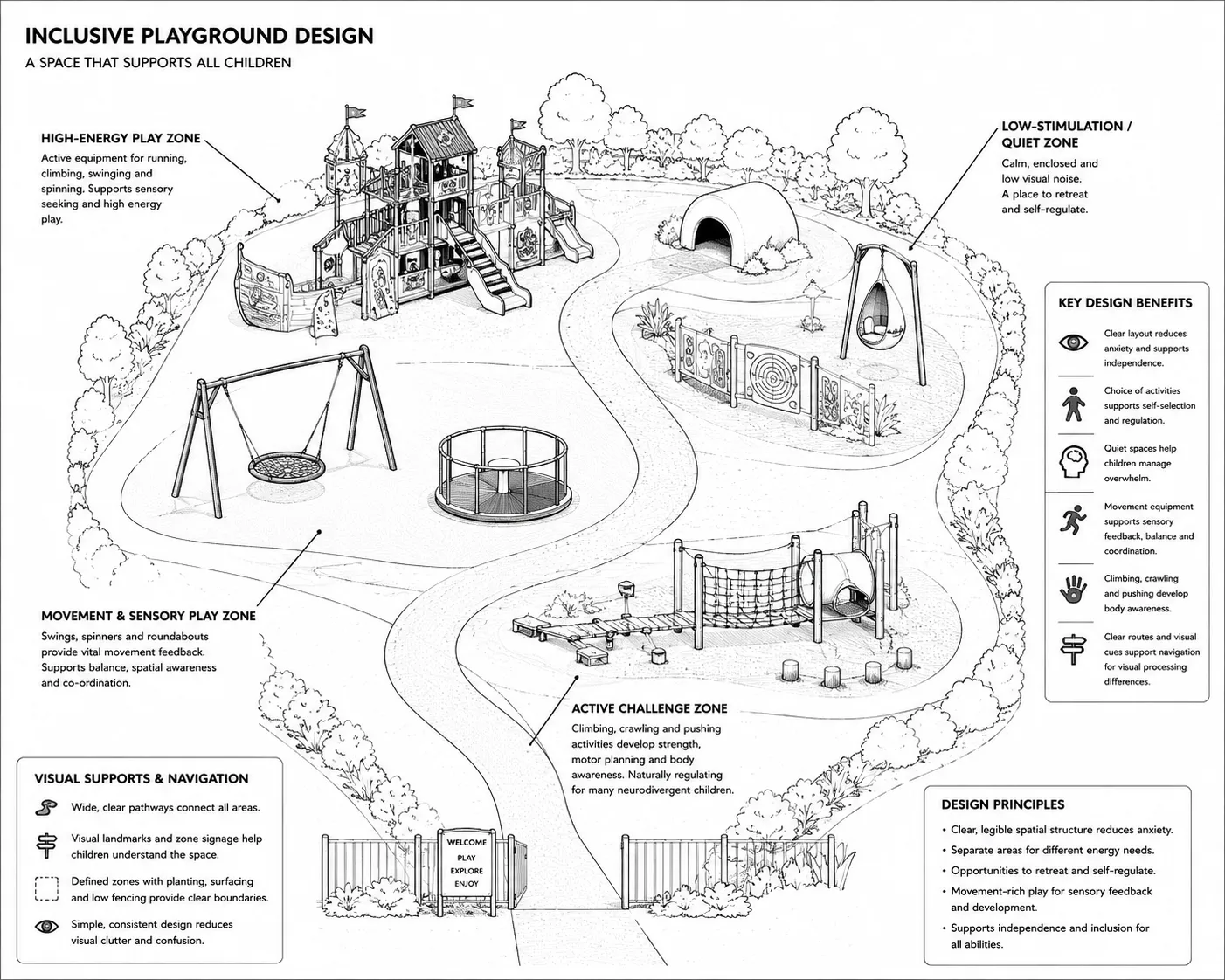
Clear, legible spatial structure reduces anxiety. Children with autism benefit from being able to see and understand the whole space at a glance.
separate areas for high-energy and low-stimulation play, clearly defined. Children need to self-select their level of engagement.
Quiet areas away from musical and high-traffic equipment — tunnels, cocoon swings, enclosed panels — allow children to self-regulate when overwhelmed.
Swings, spinners and roundabouts provide the movement feedback that helps develop balance and spatial awareness — particularly important for children with ASD and ADHD.
Climbing, crawling and pushing activities develop body awareness and are naturally regulating for many neurodivergent children.
Support children with visual processing differences in navigating the space independently.
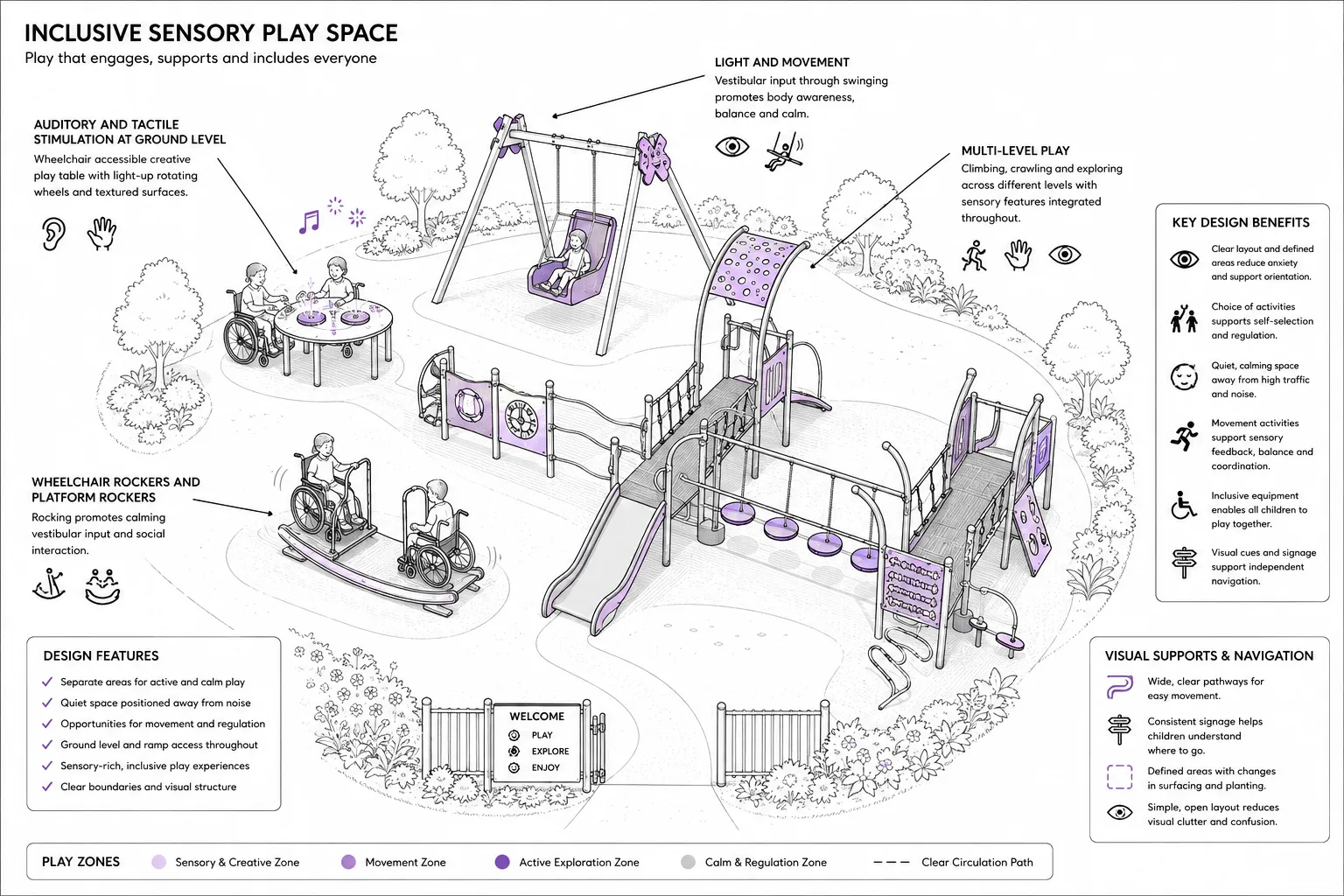
Designing for Neurodiversity: Autism, ADHD & Sensory Processing
Auditory and tactile stimulation at ground level, wheelchair accessible.
Light and movement combine vestibular input with visual sensory engagement.
Tactile, visual, low-stimulation creative play.
Vestibular input; supportive seating for children who cannot use standard flat seats.
Multi-level play with sensory features integrated throughout.
Gentle repetitive movement for self-regulation.
Inclusive Play Solutions by Sector
Inclusive play requirements differ by sector. Select yours for tailored guidance.
Schools & MATs
Legal Driver
Equality Act 2010 (reasonable adjustments, anticipatory duty) + Children and Families Act 2014 (SEND best endeavours) + school Accessibility Plan requirements.
What Morti delivers
BS EN 1176-certified inclusive and SEN equipment; full design and installation service; certification documentation for your Accessibility Plan; custom sensory zones for SEN resource bases; MAT-wide procurement pricing available.
Key equipment
Ramp-access play towers with sensory panels; wheelchair swings; sensory play tables; musical instruments; basket swings; quiet retreat spaces.

Councils & Local Authorities
Legal Driver
Public Sector Equality Duty (s.149 Equality Act) — active promotion of disability equality; not just compliance.
What Morti delivers
PiPA-aligned inclusive design process; full documentation for PSED evidence; high-traffic durable specification; SUDS-compliant inclusive surfacing; maintenance contracts available.
Key equipment
Wheelchair roundabouts and carousels; inclusive swing frames; ramp-access structures; sensory play stations; LED sensory features.

Housing Developers (S106)
Legal Driver
Section 106 planning obligations — play areas must meet inclusive design standards as a condition of consent.
What Morti delivers
Inclusive play specification ready for planning discharge; full certification and compliance documentation; design and installation coordinated around development programme; specification suitable for handover to managing agents.
Key equipment
Wheelchair-accessible swings; inclusive seesaws; sand and water play tables; ramp-access towers; accessible surfacing.

Architects & Contractors
What Morti delivers
Spec-ready product data sheets; BS EN 1176 certificates; CEN/TR 16467 compliance statements; PiPA checklist support; CAD drawings and NBS specification clauses on request; early-stage design collaboration; installer's risk assessment and method statement for building control.
Key equipment
Equipment must be installed to manufacturer instructions within BS EN 1176; surfacing must be specified as part of the inclusive design — seamless wetpour on all primary routes; approach clearances minimum 900mm for wheelchair use; contrast surfacing at level changes.
The Morti Inclusive Play Design Process
Inclusive playground design is not a product selection exercise — it is a design process. Here is how Morti works with you from brief to installation.
Site Survey & Community Consultation
Every inclusive playground starts with understanding who will use it. Morti visits the site to assess ground conditions, drainage, existing access routes, and sightlines. For schools and councils, we recommend involving children (including those with disabilities and SEN), parents, carers and SENCOs in the brief — their input shapes equipment selection and zoning in ways that desk-based design cannot.
Needs Assessment
What are the specific needs of the user group? For a mainstream primary school: what proportion of pupils have mobility difficulties, SEN, EHCPs? For a council park: what does the local community consultation say about accessibility? For a housing developer: what does the S106 obligation specify? The needs assessment shapes every subsequent decision.
Concept Design
Morti produces a concept layout showing equipment placement, zoning (active/sensory/social/retreat), surfacing specification, approach paths, sightlines and clearances. For SEN schools, we apply the principles in CEN/TR 16467 and the PiPA checklist. For mainstream schools and councils, we work to a PiPA-aligned approach. Concept designs are produced at no charge.
Equipment Specification
Once the layout is agreed, Morti specifies individual equipment items with BS EN 1176 product data sheets, fall heights, use zones, and maintenance requirements. All specifications include a surfacing recommendation — inclusive design requires inclusive surfacing; wetpour is our recommended surface on all primary routes.
Installation
Morti's CHAS-accredited installation teams work to a fully documented programme. All equipment is installed to manufacturer instructions. Post-installation, we provide a full certification pack: BS EN 1176 certificates, risk assessment, method statement, and maintenance schedule — ready for your Accessibility Plan, planning discharge or building control submission.
Standards, Accreditation & What to Ask Your Installer
BS EN 1176
BS EN 1176 is the British and European standard for playground equipment safety. All commercially installed playground equipment in the UK should be certified to BS EN 1176. It is not a legal requirement but it establishes the recognised duty-of-care standard — and courts and insurers treat it as the benchmark for negligence assessment. Always request BS EN 1176 certificates for every piece of equipment installed on your site.
CEN/TR 16467:2013
This supplementary technical report — Playground Equipment Accessible for All Children — sits alongside BS EN 1176 and provides specific guidance on designing play equipment that can be accessed and used by children of all abilities. It does not create separate 'accessible-only' products; instead it guides designers to consider inclusivity throughout the equipment design process. Morti applies CEN/TR 16467 principles across its inclusive product range.
PiPA Accreditation
PiPA (Play Inclusive Play Accreditation) is the UK's only independent accreditation for inclusive play areas. Awarded at Bronze, Silver and Gold levels, it evaluates the whole play environment — not just individual equipment — against criteria covering physical access, sensory experience, social play opportunity, and management. PiPA was endorsed by the UK Government's Accessible Britain Challenge and recognised as best practice by the British Design Council. Councils, MATs and housing developers increasingly specify PiPA-aligned design in procurement briefs. Morti can design to PiPA principles; ask us about supporting a full PiPA accreditation submission.
What to ask your installer
- BS EN 1176 certificate for every item of equipment supplied
- CEN/TR 16467 compliance statement for inclusive products
- CHAS or SSIP accreditation for the installing contractor
- Post-installation risk assessment and method statement
- Maintenance schedule and warranty conditions
- Accessible surfacing specification — wetpour on all primary routes
- PiPA-aligned design documentation (councils, MATs, S106 developers)
Funding Your Inclusive Playground
Inclusive playground projects can be funded through a range of sources. The list below covers the main routes available to UK schools, councils, and community organisations. Morti can provide cost plans, design drawings, and supporting documentation to strengthen grant applications.
UK Shared Prosperity Fund (UKSPF)
Successor to EU structural funds. Allocated to local authorities for community investment including play. Councils apply at authority level; community groups can apply through local authority programmes. Check your LA's UKSPF Investment Plan for play-relevant funding streams.
National Lottery Community Fund
Awards grants from under £10,000 to over £500,000 for community projects. Inclusive play projects with clear community benefit and co-design evidence are strong candidates. Applications require evidence of community need and inclusive outcomes.
Sport England / Active Places Power
Sport England funds physical activity infrastructure. Inclusive play areas with active play equipment are eligible. The Active Places Power tool shows existing provision gaps by area — use it to build the case for a bid.
Section 106 Developer Contributions
For housing development sites, S106 contributions fund on-site play areas as a planning obligation. The inclusive play specification should be agreed at planning stage so the budget is ring-fenced. Morti works with developers' planning consultants to specify and cost inclusive play areas for S106 submissions.
Community Infrastructure Levy (CIL)
Where CIL applies, a proportion (typically 15–25% on sites without a Parish Council) goes to the local community for infrastructure. Parish Councils and community organisations can apply for CIL neighbourhood funds to fund inclusive play improvements.
Specific Disability & SEN Grants
Various charitable funders support inclusive play for disabled children: the Whizz-Kidz Foundation, the Henry Smith Charity, the Garfield Weston Foundation, and local community foundations. Applications typically require evidence of need, disabled user involvement in design, and a sustainability plan.
School Capital Budgets
Schools in England receive Condition Improvement Fund (CIF) capital funding for building and infrastructure improvements. Inclusive play areas that support Accessibility Plan obligations are eligible expenditure. Academy trusts have greater capital flexibility through their direct DfE funding relationship.
School Playground Projects Across the UK
See how Morti Sport & Play has designed, supplied and installed school playgrounds for primary schools, SEN schools and MATs across the UK.
Frequently asked questions
Planning a playground project often raises many questions. Here are the ones we hear most often.
An inclusive playground is designed so that children of all abilities — including those with physical disabilities, sensory impairments, learning difficulties and neurodivergent conditions such as autism and ADHD — can access and enjoy the space alongside their peers. True inclusivity means a single, coherent space for everyone, not a segregated area for disabled children alongside a separate zone for everyone else.
Inclusive design aims to make a playground usable by all children from the outset — universal design applied to play. SEN-specific design goes further: it may include dedicated sensory zones, self-regulation spaces, structured layouts and equipment calibrated to specific therapeutic outcomes. All SEN playgrounds should be inclusive; not all inclusive playgrounds need to be SEN-specific.
Yes, in practical terms. Under the Equality Act 2010, schools, councils and public bodies have a duty to make reasonable adjustments to ensure disabled children are not at a substantial disadvantage — and that duty is anticipatory, meaning you must plan for it in advance. For councils, the Public Sector Equality Duty requires active promotion of disability equality. Failure to provide inclusive play can constitute disability discrimination.
PiPA (Play Inclusive Play Accreditation) is the UK's only independent accreditation scheme for inclusive play areas, awarded at Bronze, Silver and Gold levels. It evaluates the whole play environment against criteria covering physical access, sensory experience, social opportunity and management. Councils and MATs increasingly require PiPA-aligned design in their procurement briefs.
At minimum: a wheelchair-accessible swing, a roundabout with wheelchair access, and a ramp-access play tower so wheelchair users can reach elevated equipment. All must be connected by a continuous accessible surface — seamless wetpour rubber on all primary routes. Morti supplies all of these as BS EN 1176-certified products.
Key principles: a predictable, legible layout; clear zoning between high-energy and low-stimulation areas; sensory retreat spaces for self-regulation; vestibular equipment (swings, roundabouts, spinners) for sensory input; contrasting surface colours to define pathways; and ground-level sensory features accessible without climbing. Avoid excessive auditory complexity near quiet retreat areas.
Ready to Design Your Inclusive Playground?
Tell us your site, your users and your budget. Morti Sport & Play will provide a free concept design and costing for your inclusive or SEN playground — whether you are a headteacher planning a new SEN area, a council upgrading a public park, a developer meeting a Section 106 obligation, or an architect specifying for a client. We install across the UK.