.svg)
Playground Surfacing: Types, Safety Standards & Costs
Expert playground surfacing for schools, parks and councils — installed to BS EN 1177 standards across the UK.
Why Surface Choice Matters
Three things ride on getting your surfacing right: safety, accessibility and lifetime value.

Safety
Falls are the leading cause of playground injuries according to RoSPA. Certified surfacing, installed to the correct critical fall height and verified after installation, is the primary line of defence. Never accept a surfacing quote that does not specify the certified CFH for the exact build-up being installed on your site.

Accessibility
Under the Equality Act 2010, public play areas must be accessible to disabled users. Continuous unitary surfaces — wetpour rubber and safety tiles — provide firm, stable, slip-resistant routes that meet DDA intent. Loose-fill does not. Accessible design is not optional; it is a legal obligation for public-facing sites.

Lifetime
Cheap surfacing costs more over time. Wetpour correctly installed lasts 10–15 years with minimal upkeep. Bark and loose-fill require annual top-ups, drainage attention and regular contamination checks. Always calculate total cost of ownership — not day-one price.
Safety Standards Map: Every Morti Product Group
Different equipment types are governed by different British Standards. The table below maps every Morti product group to the relevant standard. Always request the certificate for the applicable standard when specifying any Morti equipment.
Safety Standards Explained: BS EN 1177 & Critical Fall Height
Safety Standards Explained: BS EN 1177 & Critical Fall Height
BS EN 1176 vs BS EN 1177
BS EN 1176 is the standard for playground equipment and surfacing requirements broadly. BS EN 1177 is the specific impact attenuation standard for surfacing — it defines how surfaces must be tested and what performance thresholds they must meet. When a supplier references 'compliant surfacing', they should mean their product is tested and certified to BS EN 1177.
What is Critical Fall Height (CFH)?
Critical fall height is the vertical drop height at which a surface's impact reading reaches HIC 1,000 or gmax 200g during standardised headform testing. Your surface's certified CFH must equal or exceed the free height of fall of every piece of play equipment on your site. If your climbing frame's highest accessible point is 2.4m, your surface must be certified to at least 2.4m CFH.
Lab cert vs installed performance
A lab certificate tells you how the surface performed under controlled conditions. Installed performance can differ due to ageing, drainage failure, UV degradation, compaction and base condition. Under BS EN 1176-1 Annex H, installed verification should be carried out after installation to confirm real-world performance. Ask your installer for a post-installation testing plan.
Compliance Checklist
- EN 1177 impact attenuation certificate — CFH for specific build-up
- Post-installation verification plan (who tests, when, what method)
- Accessible surface evidence (firm, stable, slip-resistant)
- Maintenance instructions + warranty conditions
- Installer CHAS/SSIP accreditation + public liability insurance
How to Choose the Right Playground Surface
Five questions, in order. Work through these before you request a quote and you will already know what you need.
Know Your Fall Height
Identify the free height of fall for every piece of equipment on your site — the vertical distance from the highest accessible surface to the ground beneath. Your surfacing's certified CFH must meet or exceed this. For mixed equipment, use the highest fall height on site to set your minimum.
Match Surface to Sector
Schools and nurseries: wetpour for bright colours, custom markings and seamless accessible routes.
Councils and parks: wetpour or Tiger Mulch for durability, SUDS-compliant drainage, and low maintenance on high-traffic sites.
Housing developers: rubber mulch or artificial grass for natural aesthetics, with full EN 1177 certification documentation ready for building control handover.
Set a Realistic Budget
Budget for four things: (1) surface material and labour, (2) base build-up — sub-base, drainage, edging (add 30–50% to surface-only costs), (3) post-installation testing and certification, (4) ongoing maintenance — even low-maintenance surfaces need an annual inspection.
Assess Your Maintenance Commitment
Wetpour and rubber tiles: annual visual inspection; local repairs possible. Artificial grass: brush regularly; inspect seams and infill. Grass matting: quarterly checks; confirm CFH maintained. Loose-fill bark: weekly raking; monthly depth checks; quarterly top-ups. If you cannot commit to maintenance, do not specify loose-fill.
Request Certified Evidence
Request the EN 1177 certificate for the specific build-up; confirm CHAS/SSIP accreditation; agree a post-installation verification date; get warranty terms in writing. Do not accept verbal assurances.
Safety Standards Map: Every Morti Product Group
Different equipment types are governed by different British Standards. The table below maps every Morti product group to the relevant standard. Always request the certificate for the applicable standard when specifying any Morti equipment.
Outdoor Fitness Solutions by Sector
Outdoor fitness and activity spaces serve different purposes across different sectors. Select yours for tailored guidance.

Schools & Nurseries
Best Surfaces:
Wetpour (colours + graphics), Tiger Mulch, Artificial Grass.
Key Considerations:
BS EN 1177 compliance; DDA-accessible routes; Ofsted safe environment documentation; custom playground markings for learning.
Morti delivers:
full certification documentation; custom graphic design service; CHAS-accredited installation.
Councils & Park
Best Surfaces:
Wetpour, Tiger Mulch (nature play), Grass Matting (low-impact zones).
Key Considerations:
High traffic = durability priority; SUDS-compliant drainage; RoSPA inspection-ready; public procurement compliance.
Morti delivers:
SUDS-permeable wetpour; maintenance contracts available.
Housing Developers
Best Surfaces:
Tiger Mulch, Artificial Grass, Rubber Safety Tiles.
Key Considerations:
Building Regulations Part M (accessibility); natural aesthetics; full BS EN 1177 cert pack for building control handover.
Morti delivers:
Developer-ready supply and install; programme scheduling flexibility.
Accessibility & Inclusive Play
Under the Equality Act 2010, playground operators must make reasonable adjustments to ensure disabled users can access and use play spaces. For surfacing, this means:
Firm, stable and slip-resistant routes throughout the play area — not just to the gate. Continuous unitary surfaces (wetpour or rubber tiles) on all primary routes through and around equipment. No loose-fill on accessible routes — bark and gravel create barriers for wheelchair users, pushchairs and children with mobility difficulties.
Morti installs accessible surfacing to support inclusive play design across all sectors:
Seamless wetpour on all primary routes with no trip edges. Contrasting colour bands for visually impaired users. Ramped or flush edges at level changes. Tiger Mulch on secondary paths for a natural look that maintains accessibility.
An inclusive playground starts at ground level.
Surface accessibility quick-ref
★★★ High: Wetpour (EPDM), Rubber Safety Tiles — always specify on primary routes.
★★ Medium: Tiger Mulch, Artificial Grass + Shock Pad — suitable for secondary areas; confirm seam and edge condition.
★ Low: Loose-fill bark, sand, gravel — do NOT use on accessible routes.
Sustainable Playground Surfacing
Public sector and developer clients increasingly need to demonstrate sustainability credentials. Here is what matters for UK projects.

Recycled rubber
Morti sources EPDM and SBR rubber from UK-approved suppliers with recycled content. Request a material provenance certificate confirming recycled content percentage and freedom from restricted substances under UK REACH.

UK REACH compliance
Post-Brexit, UK REACH applies. For rubber surfacing this primarily means restrictions on polycyclic aromatic hydrocarbons (PAHs) in rubber granules and mulches. Always request a UK REACH compliance statement from your installer.

SUDS compliance
Permeable wetpour and rubber tiles support sustainable urban drainage. Water drains through the surface rather than running off. Relevant for planning applications in flood-risk or water-sensitive zones — specify a permeable build-up if required by your planning consent.

End-of-life planning
Rubber surfacing is not yet widely recyclable through mainstream UK channels — plan for specialist disposal. Grass matting biodegrades. Artificial grass has an end-of-life disposal challenge; factor into your sustainability assessment.
Installation & Maintenance:
What to Expect
Installation process
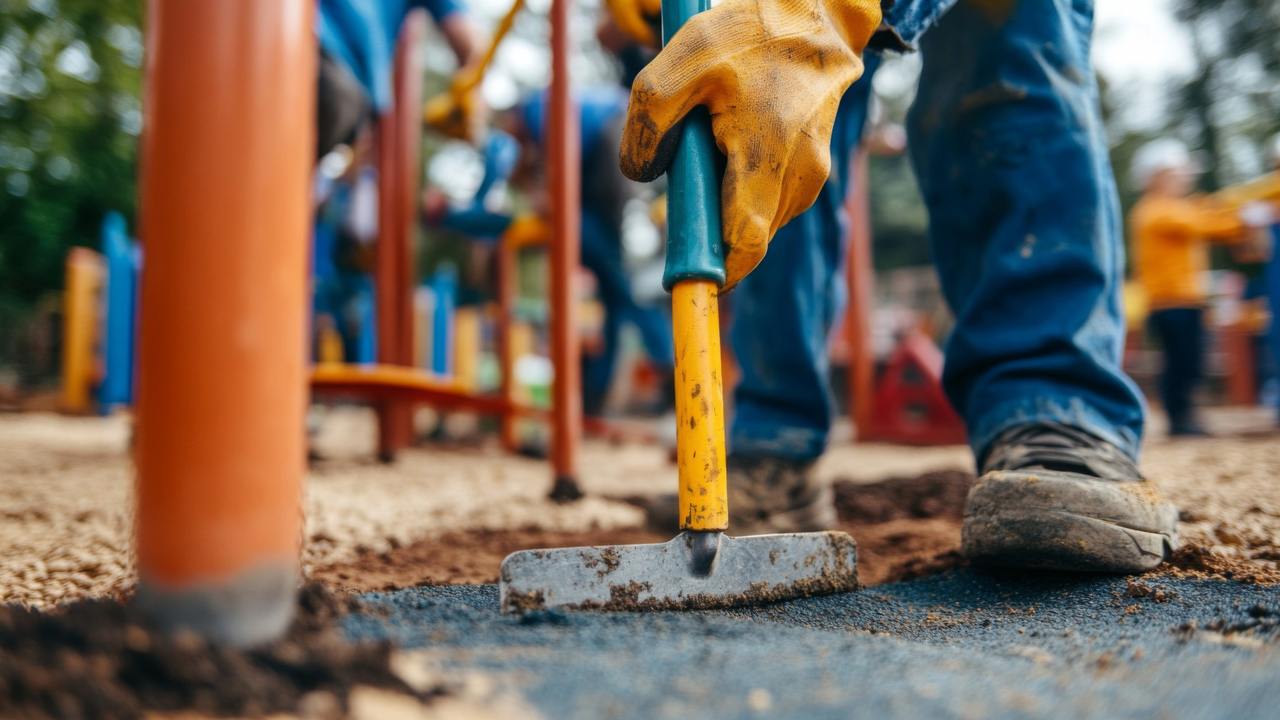
1. Site survey and base assessment — ground conditions, drainage, existing sub-base.
2. Sub-base preparation — excavation, compacted stone base, drainage channel if required.
3. Edging installation — timber, concrete or aluminium depending on specification.
4. Surface application — wetpour: 2–3 days; tiles: 1 day; artificial grass: 1–2 days.
5. Curing / drying — wetpour: 24–48 hours before foot traffic. Do not rush this.
6. Post-installation testing and certification — Morti provides EN 1177 installed verification report.
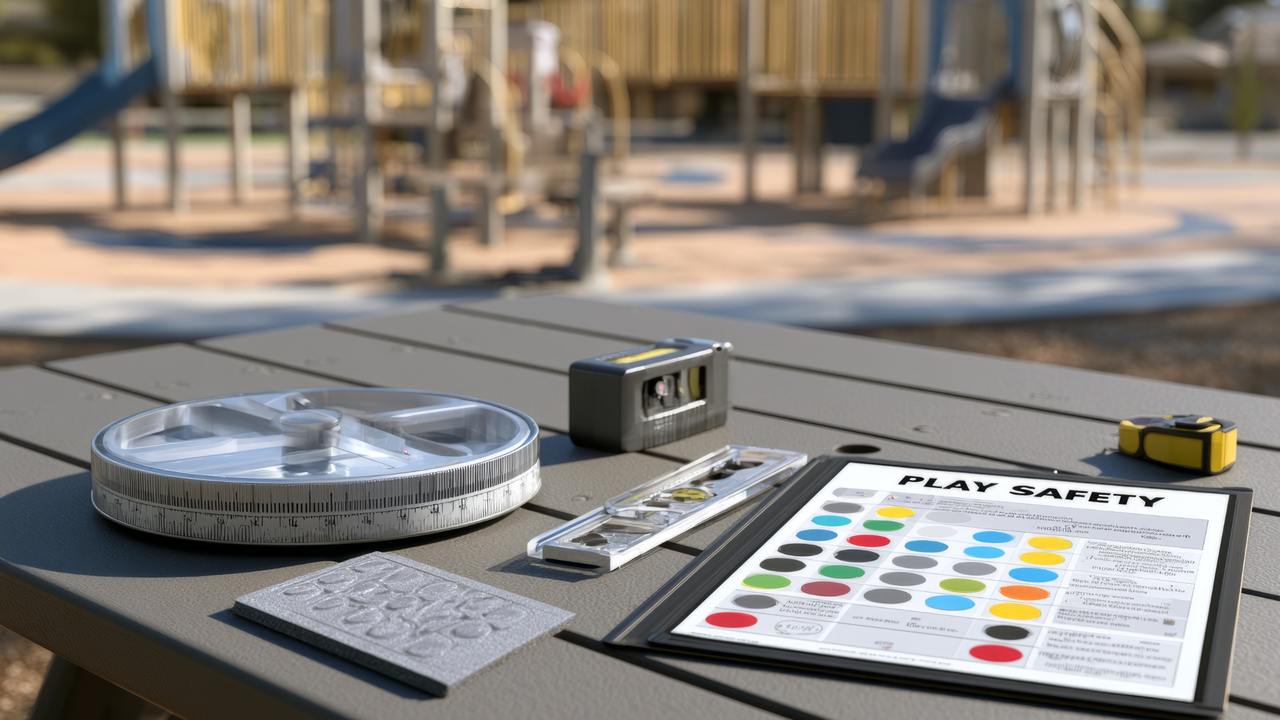
Inspection schedule
Monthly
Routine visual check — surface integrity, displacement, damage, edges.
Quarterly
Operational inspection — impact performance, drainage, contamination.
Annual
Main inspection by a competent person (RPII-qualified recommended).

Maintenance by surface type
Wetpour
Sweep debris; inspect for cracks and wear zones; repair locally before damage spreads.
Rubber tiles
Check joints and edges quarterly; replace damaged tiles.
Tiger Mulch
Inspect edge containment; check for binder breakdown.
Artificial grass
Brush pile; inspect seams; manage infill.
Grass matting
Quarterly checks; confirm CFH maintained.
Repair services CTA
Morti offers repair and rejuvenation for wetpour, rubber mulch and artificial grass. Address small damage early — it prevents a patch job becoming a full replacement.
Recent Playground Surfacing Projects
See how Morti Sport & Play has transformed outdoor spaces for schools, councils and developers across the UK.
Frequently asked questions
Planning a playground project often raises many questions. Here are the ones we hear most often.
BS EN 1177 is the British and European standard for playground impact-attenuating surfacing. It specifies how surfaces must be tested using an instrumented headform and sets the performance thresholds (HIC 1,000 and gmax 200g) that surfaces must meet to be certified compliant. Any reputable installer will provide a BS EN 1177 certificate for the system they install.
Wetpour thickness depends on the fall height it needs to protect against. As a guide: around 40mm total (base + wear course) for fall heights up to approximately 1m, rising to 75mm or more for fall heights around 3m. Your installer should provide a product-specific depth-vs-CFH table — never accept a fixed depth figure without the certified CFH it corresponds to.
Wetpour installed correctly and maintained annually typically lasts 10–15 years. Wear zones — under swings, at slide exits, and around climbing frame bases — may show earlier wear and benefit from localised top-ups. Neglecting drainage or allowing standing water accelerates degradation.
Yes, when installed correctly. Artificial grass alone does not provide impact attenuation — you must specify a certified shock-absorbing pad beneath the grass, and the total system (pad + grass) must be tested and certified to BS EN 1177 for the required fall height. Always ask for the system CFH certificate, not just a grass specification sheet.
Loose-fill bark or wood chips have the lowest upfront supply cost, but they require frequent top-ups, quarterly raking, drainage maintenance and contamination removal. Over five years, well-installed wetpour is typically more cost-effective. Always compare total cost of ownership, not day-one price.
Generally no, but check with your local planning authority if the site is listed, in a conservation area, or subject to conditions from a previous planning consent. Sites in flood-risk zones may need to demonstrate SUDS-compliant drainage, which affects surface specification.
RPII guidance recommends three levels: monthly routine visual checks; quarterly operational inspections (impact performance, drainage, contamination); and annual main inspections by a competent person. Surfacing condition must be included in each inspection and records kept.
Yes. Localised damage — cracks, holes, delamination, worn patches — can be repaired without replacing the entire surface, provided the substrate is sound and the repair material matches the original specification. Morti offers repair and maintenance services. Addressing small damage early prevents it spreading and extends surface life significantly.
Wetpour rubber or rubber safety tiles on all primary routes through and around equipment. Do not specify loose-fill on any accessible route. Tiger Mulch is acceptable on secondary paths in nature-play zones provided edge and level transitions are managed.
Potentially yes. If new equipment has a higher free height of fall than the existing surfacing was certified for, the surfacing must be upgraded to maintain BS EN 1177 compliance. Always check the certified CFH of your existing surfacing against the fall height of any new equipment before installation.
Ready to Design Your Outdoor Fitness Space?
Tell us your site type, equipment fall heights and budget. Morti Sport & Play will recommend the right surface system and provide a free, no-obligation quote. We install across the UK — schools, parks, councils and housing developments.
Explore Further
Browse Morti's full range of surfacing products or get guidance for your specific sector.