.svg)
Playground Safety & Compliance: Standards, Inspections & Duty of Care | UK
The complete guide to safety standards, inspection requirements and legal duty of care for playground equipment, outdoor gyms, MUGAs, parkour and play surfacing in the UK.
Why Safety & Compliance Matters

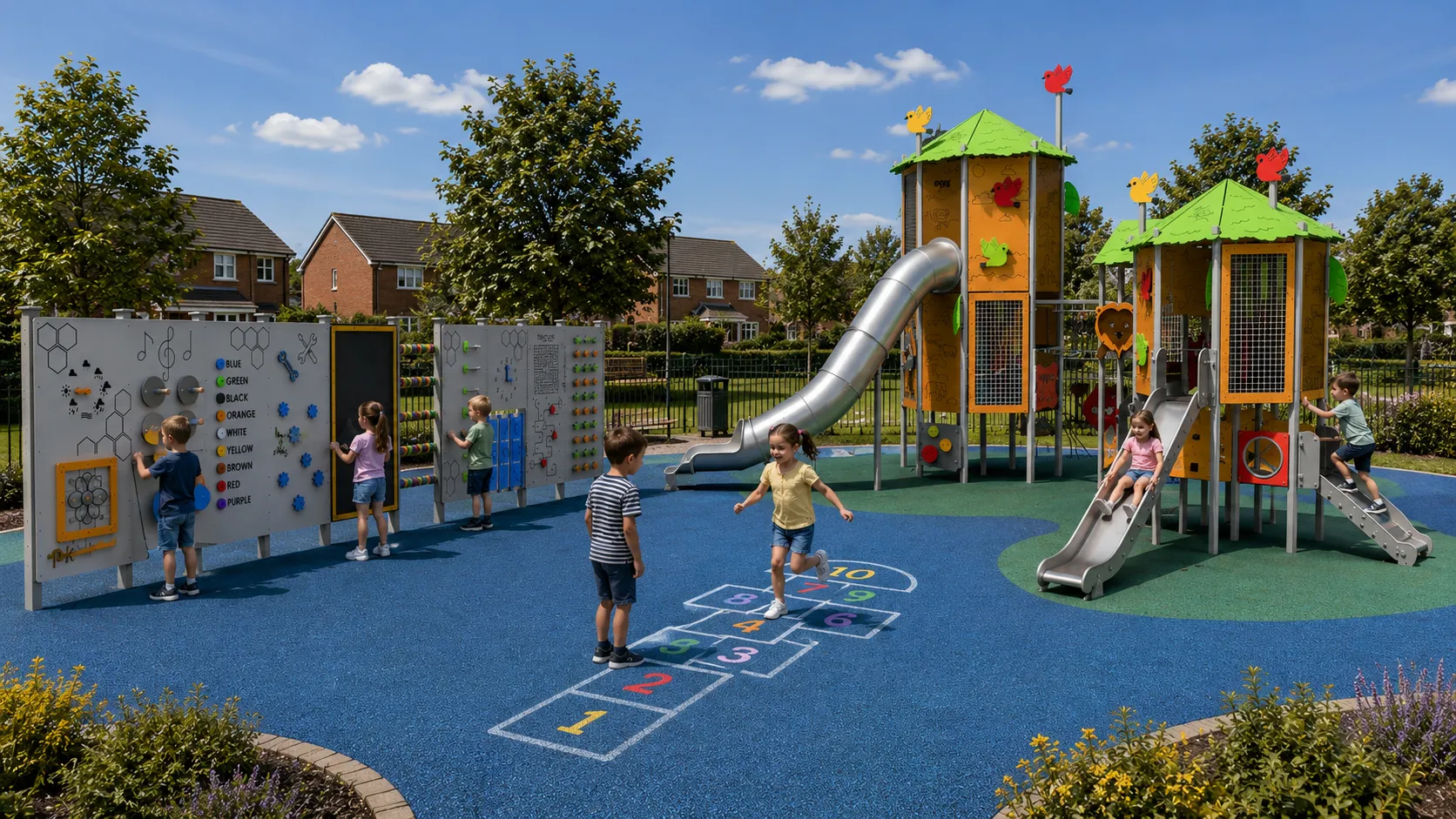
Legal protection
The Health and Safety at Work Act 1974 imposes a duty on playground operators to ensure the safety of users so far as is reasonably practicable. The Occupiers' Liability Acts 1957 and 1984 require that visitors can expect to be reasonably safe. British Standards are not legally mandated, but courts look to compliance with BS EN 1176 and the relevant standards as evidence of whether the duty of care has been met. Non-compliance can be viewed as negligence.

Insurance
Insurers increasingly require evidence of compliance with relevant British Standards and a documented inspection regime. An annual RPII-qualified inspection report, maintenance records, and equipment certificates are the documents most often requested following an incident. Gaps in documentation are frequently cited in successful claims against playground operators.

Children's safety
Around 40,000 children suffer playground injuries in UK schools annually. Falls account for approximately 70% of all playground accidents. Properly specified equipment certified to BS EN 1176, installed with appropriate BS EN 1177 surfacing, and maintained through a regular inspection regime significantly reduces the risk of serious injury. Compliance is not paperwork — it is what keeps children safe.
The UK Legal Framework for Playground Safety
Several pieces of UK legislation impose duties on playground and outdoor fitness operators. None specifically mention playgrounds — they are general safety and occupier laws applied to play areas when incidents occur.
The primary legislation covering playgrounds. Imposes a duty to ensure the health and safety of non-employees so far as is reasonably practicable. The HSE looks for a systems approach to safety — a structured inspection regime, maintained records, and compliance with recognised standards.
Requires a risk assessment of facilities, a written safety policy, and appropriate staff training. For playground operators: a documented risk assessment per play area, a safety policy covering inspection and maintenance, and trained staff carrying out routine and operational inspections.
Requires that visitors can expect to be reasonably safe when using the playground. Greater care is required where children are concerned.
Extends a limited duty of care to trespassers in respect of risks an occupier might reasonably be expected to offer some protection against. Relevant for play areas accessible outside supervised hours.
Makes manufacturers and suppliers liable for injuries resulting from defective products. Reinforces the importance of specifying equipment from certified manufacturers with full product documentation.
Emphasises the duty to safeguard the welfare of children. Courts have applied this to play area design, maintenance and supervision.
Certain playground accidents must be reported: local authority and school playgrounds to the HSE; commercial and voluntary sector to the local Environmental Health Office.
Safety Standards Map: Every Morti Product Group
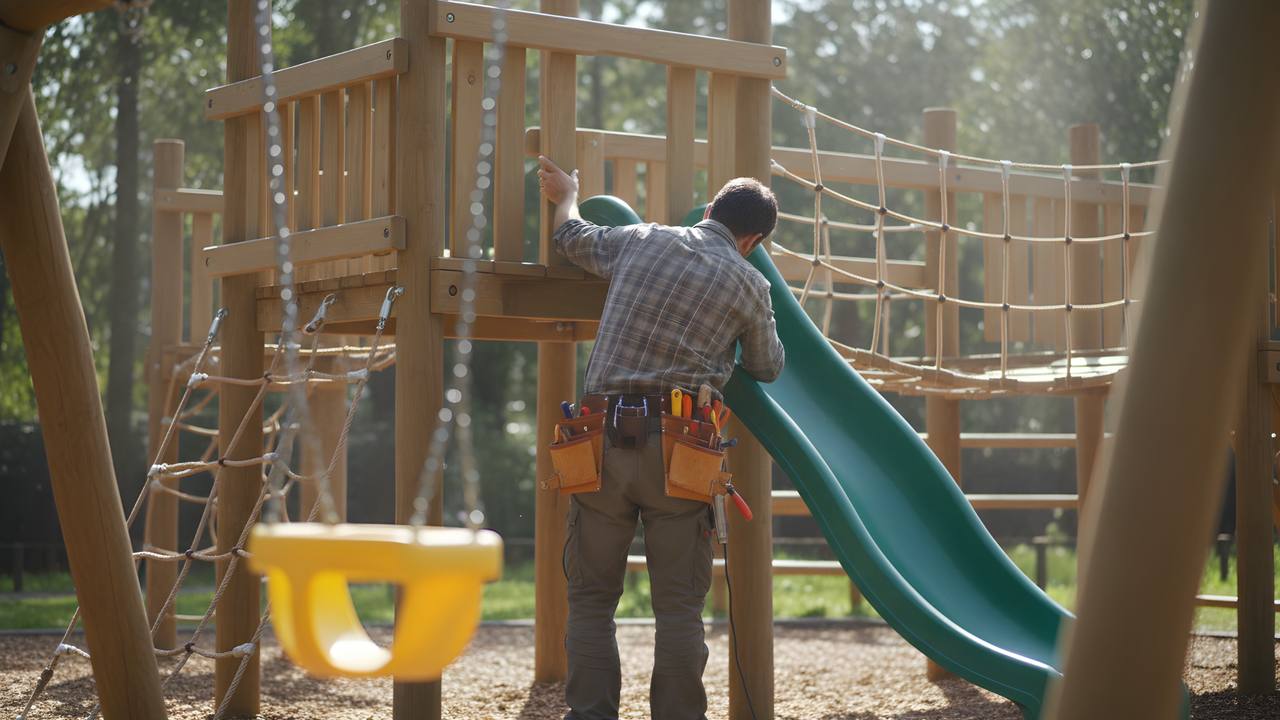
Different equipment types are governed by different British Standards. The table below maps every Morti product group to the relevant standard. Always request the certificate for the applicable standard when specifying any Morti equipment.
Design Guidance
(FA/LTA/Basketball)
BS 8409

BS EN 1176: The Playground Equipment Standard Explained
BS EN 1176 is the British adoption of the European standard EN 1176, published in multiple parts between 2017 and 2023. It is the primary safety standard for all publicly installed playground equipment in the UK. It is not a legal requirement, but it is the recognised benchmark against which courts, insurers and the HSE assess whether a playground operator has met their duty of care.
Part 1: General safety requirements and test methods (all equipment).
Part 2: Swings. Part 3: Slides. Part 4: Runways. Part 5: Carousels. Part 6: Rocking equipment.
Part 7: Installation, inspection, maintenance and operation — the inspection regime guidance.
Part 10: Fully enclosed play equipment (indoor soft play).
Part 11: Spatial networks (rope and net equipment).
All Morti playground equipment is certified to BS EN 1176.
Equipment certified to BS EN 1176 has been designed, manufactured and independently tested to the standard. A Declaration of Conformity should be provided for every piece of equipment. Equipment must also be installed to manufacturer's instructions — installation that deviates voids compliance.
BS EN 1176 is the British adoption of the European standard EN 1176, published in multiple parts between 2017 and 2023. It is the primary safety standard for all publicly installed playground equipment in the UK. It is not a legal requirement, but it is the recognised benchmark against which courts, insurers and the HSE assess whether a playground operator has met their duty of care.
BS EN 1176 Part 7 specifies that surfacing must be provided in the use zone around all equipment with a fall height above a certain threshold. BS EN 1177 sets out the surfacing requirements — the critical fall height (CFH) the surface must achieve. The surface's certified CFH must equal or exceed the equipment's free height of fall. This must be verified for the installed system, not just stated on a certificate.
BS EN 1176 explicitly acknowledges that play involves risk and that the goal is to eliminate unacceptable risk — not all risk. Challenge and the risk of minor injury are recognised benefits of play that the standard deliberately preserves. Over-restrictive specification that removes all challenge produces play spaces children do not use.
BS EN 16630, BS EN 16899 & Sports Facility Standards
BS EN 16630:2015 — Outdoor Fitness Equipment
BS EN 16630 covers permanently installed outdoor fitness equipment for users over 1,400mm tall. It specifies general safety requirements for manufacture, installation, inspection and maintenance.
Key requirements: Equipment must be free of shear points, crush points and sharp edges. Moving mechanisms must have safety stops. A minimum 1.5m clear training space must surround every unit. Equipment must not be installed in the immediate vicinity of children's playgrounds.
All Morti adult outdoor gym equipment is independently tested and certified to BS EN 16630. Certificates are provided with every installation.
BS EN 16899:2016 — Parkour Equipment
BS EN 16899 covers sports and recreational parkour equipment — permanently installed parkour structures. It specifies safety requirements and test methods. Morti's parkour range is supplied with BS EN 16899 certification. When parkour equipment is installed adjacent to a children's playground, zone separation requirements of both BS EN 1176 and BS EN 16630 should be considered.
Sport England Technical Design Guidance — MUGAs
MUGAs do not have a single British Standard equivalent to BS EN 1176. They should be designed and constructed in accordance with Sport England Technical Design Guidance for Multi-Use Games Areas. For facilities used for Sport England-funded programmes, or specific sports, additional NGB accreditation testing may be required.
Non-Standard Products
For product types not covered by a specific British Standard, a site-specific risk assessment prepared by a competent person is required. The risk assessment becomes the compliance evidence in the absence of a relevant standard.
The Inspection Regime: What BS EN 1176 Part 7 Requires
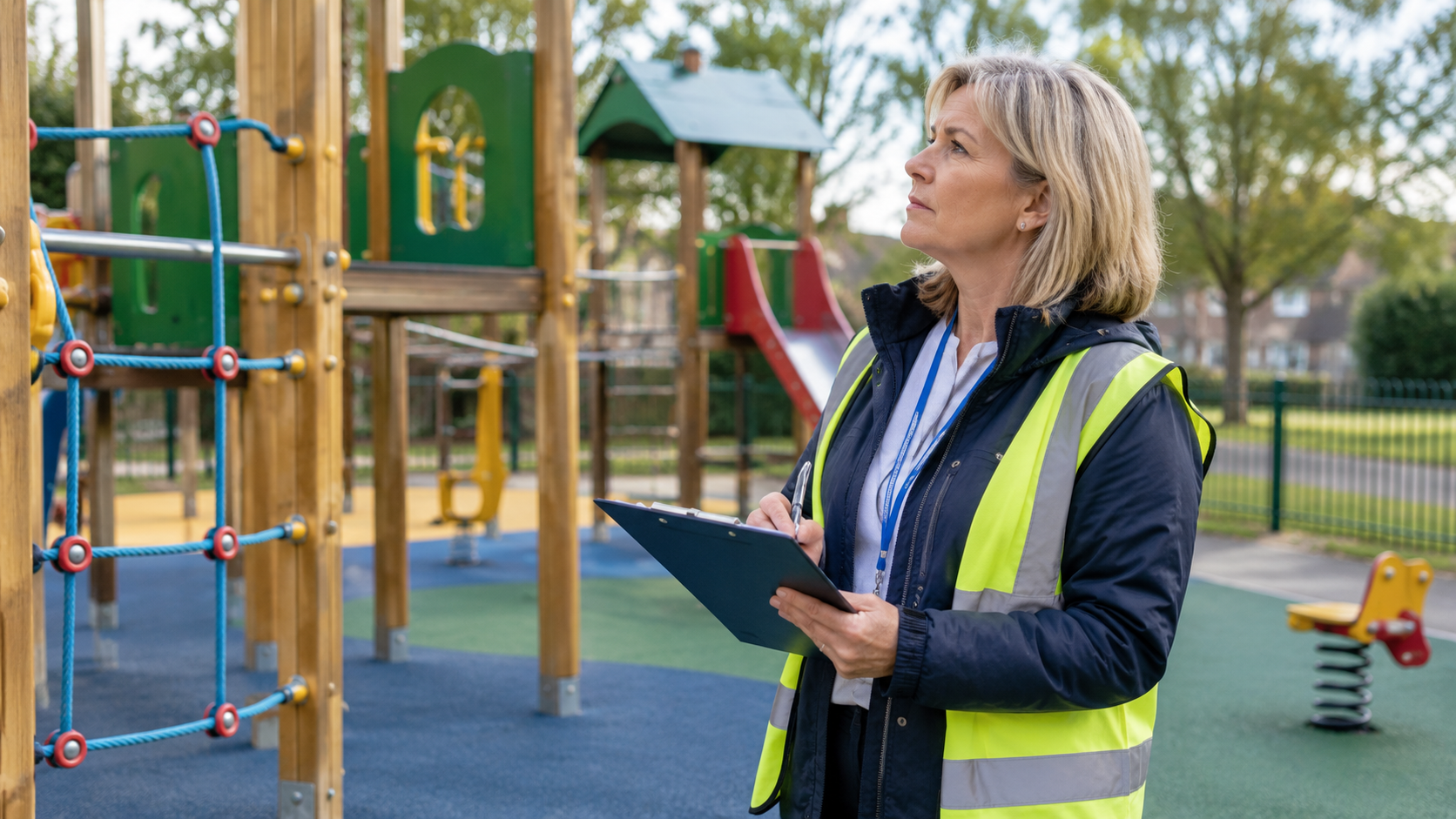
Routine Visual
Trained in-house staff. Must be trained — can be caretaker or delegated staff member.
Quick visual check: visible damage, vandalism, sharp edges, missing parts, litter, surface condition. Record findings. Close equipment immediately if immediate danger identified.
Operational
RPII-registered Operational Inspector. Trained staff can be RPII-certified at this level.
Detailed hands-on: all fixings tight, equipment stable, no excessive wear or corrosion, moving parts functioning, gates operating, surfacing depth and condition. Full written report.
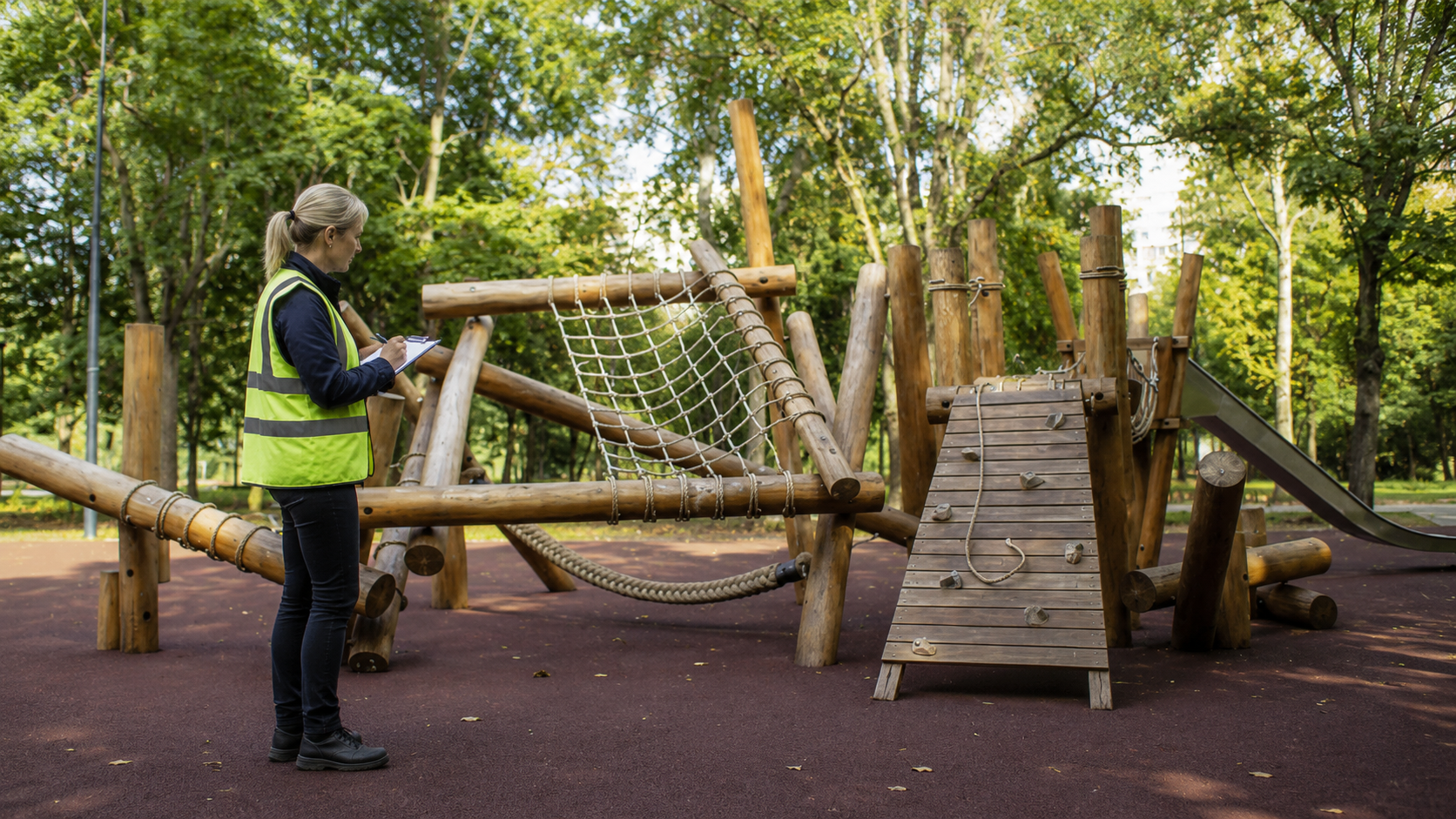
Annual (Main)
Independent RPII-qualified Annual Inspector. Must be independent of the installer and the operator — cannot be in-house.
Comprehensive structural assessment: foundation integrity, overall condition against applicable standard, risk assessment, surfacing CFH compliance, inclusive design assessment. Written report with graded recommendations.

Post-Installation
Independent RPII-qualified inspector. Must be independent of the company that carried out the installation.
Confirms installation to manufacturer's instructions and relevant standard. Required before equipment opens to users. Morti recommends clients arrange this before site opening.
The RPII is the official UK body for certifying playground inspectors. RPII registration is the recognised qualification for annual and operational inspectors. Always confirm that your annual inspector is RPII-registered.
Risk-grade the defect: immediate danger = close equipment now; potential danger = act within days; low risk = schedule maintenance. Record the finding, risk grade, and action taken. If equipment is closed, display clear signage. Do not re-open until the repair is complete and verified. Keep all records for a minimum of five years.
Risk Assessment & Documentation:
What You Need

Site Risk Assessment
Identify: equipment and activities; hazards each presents; likelihood and severity of harm; control measures; and responsible persons. Review annually and after any changes.

Equipment Certificates
For every piece of equipment, obtain and retain: Declaration of Conformity confirming compliance with the applicable standard; product data sheet; manufacturer's installation and maintenance instructions.
Installation Records
Retain the installer's written confirmation of installation to manufacturer's instructions and applicable standard. Where a post-installation inspection has been carried out, retain the inspector's report.

Maintenance Log
Record every maintenance action: date, who, what was done, parts replaced. If equipment is repaired after a defect is found, record the repair date and the date equipment returned to service.
Incident Records
Record any accident or near-miss: date, time, description, equipment involved, injury, actions taken. Retain all incident records. Report RIDDOR-reportable incidents to the appropriate authority.
Buying Safe Equipment:
The Compliance Checklist
When specifying any outdoor equipment from any supplier, these are the compliance documents you should receive before accepting delivery or opening the site.
For playground equipment (BS EN 1176)
- Declaration of Conformity for each product (BS EN 1176, relevant part)
- Product data sheet with critical fall height table
- Manufacturer's installation instructions
- Manufacturer's maintenance scheduleWarranty conditions
- CHAS/SSIP accreditation for the installerWritten installation confirmation
- Post-installation RPII inspection report
For outdoor gym equipment (BS EN 16630)
- Declaration of Conformity (BS EN 16630:2015)
- Product data sheet with training space and fall zone dimensions
- Confirmation equipment is not adjacent to children's playground
- Maintenance schedule
- Post-installation inspection report
For parkour equipment (BS EN 16899)
- Declaration of Conformity (BS EN 16899:2016)
- Product data sheet
- Site-specific risk assessment for the parkour zone
- Post-installation inspection report
For MUGAs
- Confirmation design meets Sport England Technical Design Guidance
- Surface specification and test certificate
- NGB accreditation documentation where applicable
- Drainage specification
- Post-installation inspection report
For play surfacing (BS EN 1177)
- Impact attenuation test certificate (EN 1177) showing CFH for the specific system build-up
- Post-installation verification report confirming installed CFH
- Maintenance instructions and drainage specification
Sector-Specific Compliance Notes

Schools & MATs
Schools have duty of care under H&S at Work Act and Occupiers' Liability Act. Ofsted will ask about outdoor safety provision and risk assessments. Schools must maintain an Accessibility Plan under the Equality Act 2010 addressing outdoor play. MATs should establish a group-wide inspection policy ensuring consistent compliance across all sites.
Councils & Local Authorities
RIDDOR-reportable incidents at council parks go to the HSE. The Public Sector Equality Duty requires active promotion of disability equality extending to play and fitness provision. Annual RPII inspections for all council-managed play areas are strongly recommended and frequently specified in council procurement contracts.
Housing Developers (S106)
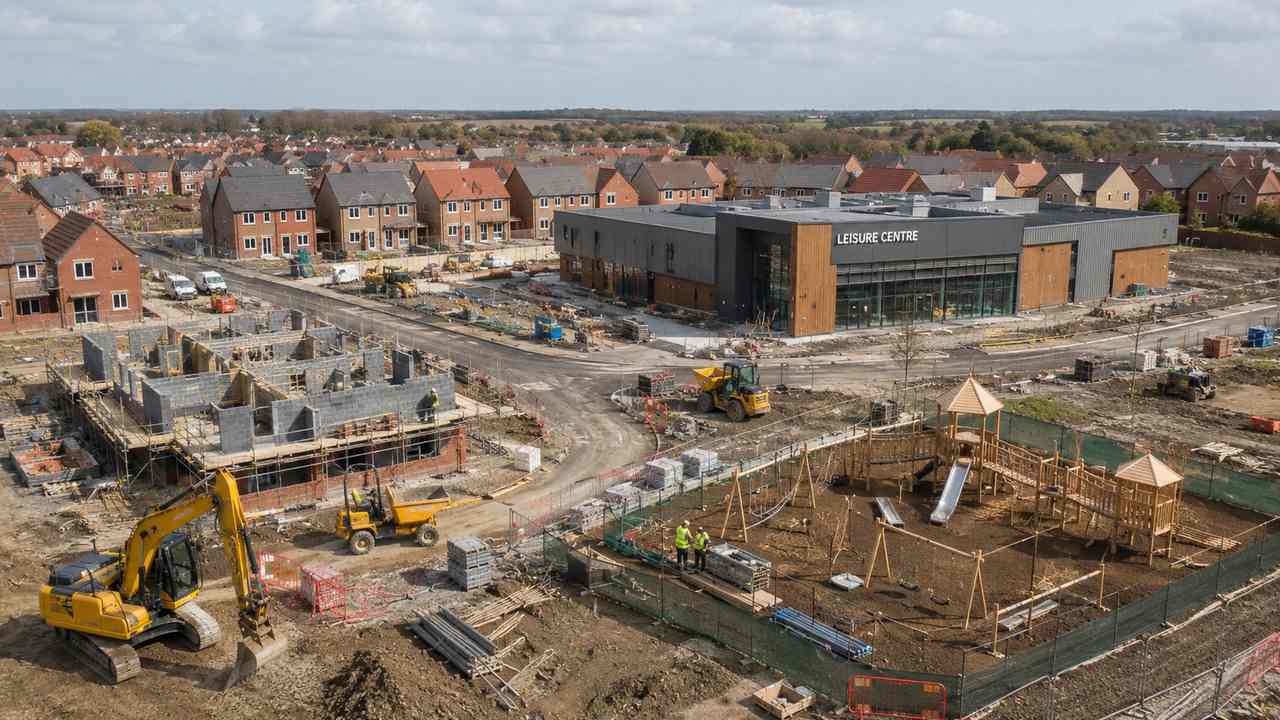
Developers must ensure equipment meets standards specified in planning consent. Documentation (Declaration of Conformity, post-installation report, maintenance schedule) should be included in the handover pack to the managing agent or residents' management company.
Commercial / Leisure Operators
RIDDOR-reportable incidents go to the local Environmental Health Office. Insurance cover for public liability typically requires evidence of regular inspection; many policies now specifically require RPII annual inspections.
Architects & Contractors
Specification documents should reference the applicable British Standard for each product type. NBS specification clauses are available for BS EN 1176 equipment. The installer's CHAS/SSIP accreditation should be checked before appointment. Post-installation independent RPII inspection should be specified in the contract.
Morti's Safety & Compliance Credentials
Every Morti installation comes with a full compliance documentation pack as standard.
Standard documentation on every Morti installation
- Declaration of Conformity for every product item (BS EN 1176, BS EN 16630 or BS EN 16899 as applicable)
- Product data sheets including CFH tables and training zone dimensions
- Installation confirmation letter
- ost-installation inspection facilitation (independent RPII inspector arranged on request)
- Maintenance schedule and warranty documentation
- Risk assessment and method statement for the installation programme
Frequently asked questions
Planning a playground project often raises many questions. Here are the ones we hear most often.
No — BS EN 1176 is not a legal requirement. However, it is the recognised benchmark that courts, insurers and the HSE use to assess whether a playground operator has met their duty of care. Non-compliance with BS EN 1176 can be treated as evidence of negligence if an incident occurs. Compliance does not guarantee immunity from legal claims, but it provides strong evidence that appropriate measures were taken.
The primary legislation is the Health and Safety at Work etc. Act 1974 (sections 3 and 4), the Occupiers' Liability Acts 1957 and 1984, and the Management of Health and Safety at Work Regulations 1999. The Consumer Protection Act 1987 makes manufacturers liable for defective products. None specifically mention playgrounds — they are general safety laws applied to play areas.
BS EN 1176 is the safety standard for playground equipment — covering design, manufacture, installation and maintenance. BS EN 1177 is the safety standard for play surfacing — covering impact attenuation and critical fall height. The two work together: EN 1176 specifies that surfacing must be provided; EN 1177 specifies what that surfacing must achieve.
BS EN 16630:2015 applies to permanently installed outdoor fitness equipment for users over 1,400mm tall. It states adult outdoor gym equipment must not be installed in the immediate vicinity of children's playgrounds. For children's outdoor gym equipment, BS EN 1176 test methods apply.
BS EN 16899:2016 is the British and European standard for sports and recreational parkour equipment. All Morti parkour equipment is supplied with BS EN 16899 certification.
BS EN 1176 Part 7 recommends: routine visual inspections weekly (daily for high-use sites) by trained staff; operational inspections every 1–3 months by an RPII-registered inspector; and an annual main inspection by an independent RPII-qualified annual inspector. A post-installation inspection is also required after any new installation before the site opens.
RPII (Register of Play Inspectors International) is the official UK body for certifying playground inspectors. RPII qualification is the recognised standard for operational and annual inspections. Annual inspections must always be carried out by an RPII-qualified inspector who is independent of the playground operator and the equipment installer. Find RPII inspectors at playinspectors.com.
At minimum: a Declaration of Conformity for each product; a product data sheet including critical fall height information; manufacturer's installation and maintenance instructions; warranty conditions; and the installer's CHAS/SSIP accreditation. After installation: written installation confirmation and a post-installation inspection report from an independent RPII inspector.
Yes. Schools have duty of care under the H&S at Work Act and Occupiers' Liability Act. Ofsted will assess whether risk assessments have been conducted and whether surfacing is suitable. Schools must maintain an Accessibility Plan under the Equality Act 2010 addressing outdoor play. RIDDOR-reportable incidents must be reported to the HSE.
Critical fall height (CFH) is the maximum drop height from which a person can fall onto a surface without the impact exceeding the Head Injury Criterion (HIC) threshold of 1,000. The surface's certified CFH must equal or exceed the free height of fall of the tallest accessible point on the equipment above it, tested under BS EN 1177.
Yes, but it requires a site-specific risk assessment prepared by a competent person. This risk assessment becomes the compliance evidence. The product should still be structurally sound and free of entrapment hazards consistent with BS EN 1176 principles. Morti prepares risk assessments for bespoke or non-standard products.
Failure to maintain equipment, or failure to record that maintenance was carried out, leaves the operator exposed in the event of an accident. Courts look for a documented safety system. Insurers may decline or limit claims where maintenance cannot be evidenced. In serious cases, failure to maintain can result in prosecution under the H&S at Work Act.
Need Certification Documentation or a Compliance Check?
Morti Sport & Play provides full certification documentation with every installation — Declaration of Conformity, product data sheets, installation confirmation, and post-installation inspection facilitation. If you need documentation for an existing installation, or want to discuss compliance requirements for a new project, contact us.