
.svg)
School Playground Design & Installation: Equipment, Funding & Compliance | UK
Complete school playground solutions for primary schools, EYFS settings, SEN schools and MATs — designed, supplied and installed across the UK by Morti Sport & Play.
Why Your School Playground Matters

Development
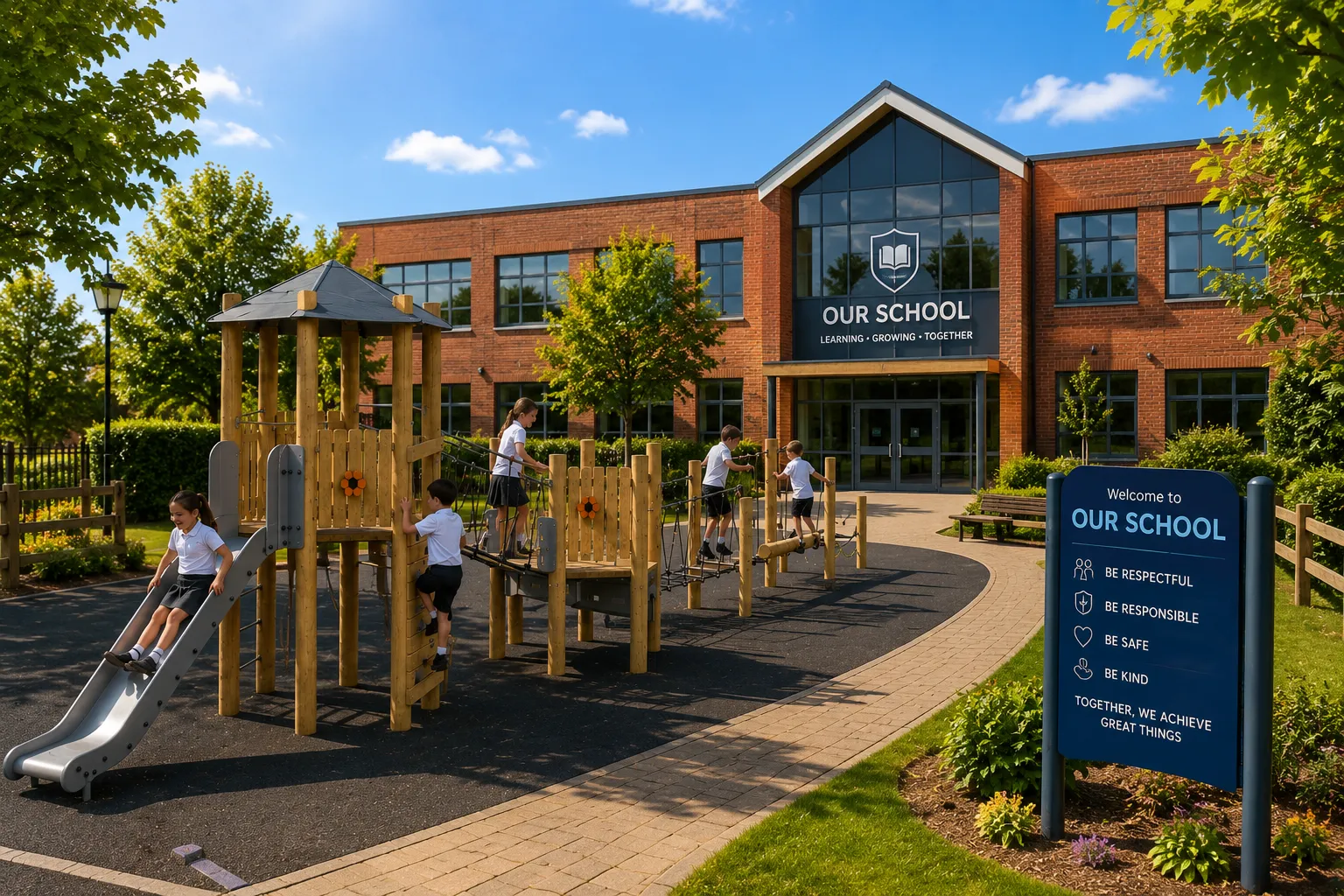
Research consistently shows that outdoor play is essential to children's physical and cognitive development. Children who have access to varied, challenging play environments develop stronger gross motor skills, better balance and coordination, greater resilience, and improved social skills. In primary schools, this translates to measurable improvements in classroom focus and behaviour. Play is not a break from learning — it is learning.

Compliance
For EYFS settings, outdoor provision is a statutory requirement under the Early Years Foundation Stage framework. Paragraph 3.68 of the updated 2025 EYFS framework requires providers to ensure children have access to an outdoor play area on a daily basis. For all primary schools, Ofsted inspectors assess the quality and variety of outdoor provision as part of their evaluation of the school's curriculum and physical development. A well-designed playground provides evidence for your inspection.

Value
A well-specified school playground lasts 15–25 years. Equipment certified to BS EN 1176 with appropriate surfacing, installed by a CHAS-accredited contractor and maintained through a regular inspection regime, provides decades of value with minimal lifecycle cost. The real cost of a poor-quality playground is not the purchase price — it is the maintenance, the early replacement, the safety risk, and the missed opportunity to support pupil outcomes.
Policy & Compliance: What Schools Must Consider
Several policy frameworks and legal obligations shape what a school playground must deliver. Understanding them helps you make the right specification decisions — and demonstrate compliance to Ofsted, governors, and the LA.
LAW/POLICY: The EYFS outdoor provision requirement is a statutory obligation — not a recommendation. Schools and settings that cannot provide an outdoor play area must ensure planned outdoor activities are taken daily. This is inspected by Ofsted.
The Early Years Foundation Stage statutory framework (updated September 2025) requires all group and school-based providers to ensure premises, including outdoor spaces, are fit for purpose and suitable for the ages of children in the setting (para 3.64). Para 3.68 specifically requires providers to ensure access to an outdoor play area on a daily basis — or, where this is not possible, to ensure that outdoor activities are planned and taken daily. This is not guidance — it is a statutory requirement. Morti designs EYFS outdoor environments that meet this requirement and can withstand daily use by children aged 2–5.
Ofsted inspectors assess physical development as part of the Personal Development judgement across all key stages. Inspectors look for: a stimulating and varied outdoor environment; evidence that outdoor provision supports curriculum intent across EYFS, KS1 and KS2; equipment and spaces that support different types of play and physical development; and inclusive design that allows all pupils to participate. Schools that can articulate how their playground supports curriculum, physical development and inclusion are in a stronger position at inspection.
Schools have an anticipatory duty under the Equality Act to make reasonable adjustments for disabled pupils. For the outdoor environment, this means inclusive play equipment that allows disabled and non-disabled children to play alongside each other must be considered from the outset — not added later. Morti's inclusive design approach, combined with equipment certified to BS EN 1176 and CEN/TR 16467, supports schools in meeting this obligation. Schools must also maintain an Accessibility Plan that addresses outdoor play provision.
and BS EN 1176
Schools have a duty of care for all children using outdoor equipment. This requires: equipment certified to BS EN 1176; appropriate surfacing certified to BS EN 1177; a regular inspection regime (routine, operational, annual RPII); and documented risk assessments. Morti provides full certification documentation with every installation. See the Playground Safety & Compliance guide for full detail.
Primary schools in England receive PE & Sport Premium funding: £16,000 base + £10 per eligible pupil (2025/26). The total national pot is £320 million. Schools must spend this funding on additional and sustainable improvements to PE, sport and physical activity. Capital expenditure — equipment that becomes a recognised asset on the school's balance sheet above the de minimis threshold — is not eligible. Activity-enabling improvements below the de minimis threshold, and revenue-type improvements, may be eligible. Morti advises schools on how to classify playground expenditure correctly relative to this funding.
School Playground Equipment by School Type
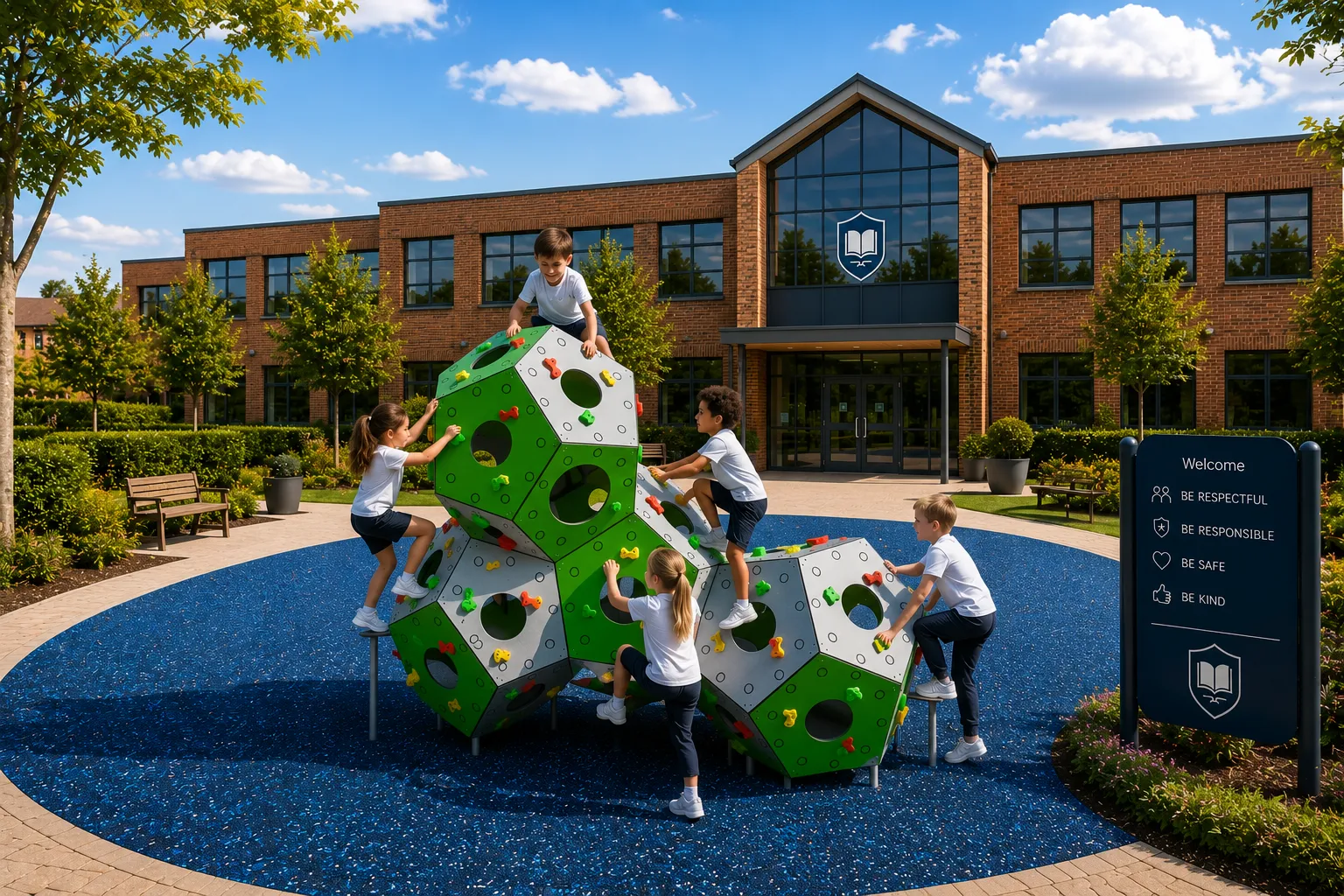
Every school is different. The right playground for a Reception class is not the right playground for a Year 9 PE facility — and both are different from the right environment for a SEN resource base. The table below maps equipment categories to school type, age range, Morti product ranges, and the relevant funding hook.

EYFS & Nursery
Key Equipment Categories
Age-appropriate small climbing frames, sand & water play, springers & rockers, musical instruments, sensory features, soft surfacing, outdoor classroom furniture
Ledon / Robina Ranges
Ledon MiniPlay (gentle challenge, age 0–6); Robinia Timber (natural aesthetic, no preservatives)
Funding Hook
EYFS statutory requirement — must have outdoor provision daily (para 3.68 EYFS framework 2025). DfE nursery capital funding. Pupil premium early years.
Primary — KS1
Key Equipment Categories
Trim trails & obstacle courses, climbing frames, swings, seesaws, spinners, musical instruments, sand & water play, playground markings, inclusive equipment
Ledon / Robina Ranges
Ledon Basic (starter range, simple challenges); Ledon Explore (graduated challenge, broad range)
Funding Hook
PE & Sport Premium (revenue-eligible improvements). School capital budgets (Condition Improvement Fund for academies).
Primary — KS2
Key Equipment Categories
Climbing stacks, fitness trails, trim trails, MUGAs, children's outdoor gym, parkour features, seesaws, zip lines, trampolines, climbing nets, team play structures
Ledon / Robina Ranges
Ledon Explore (larger, more complex); Robinia Timber (natural play)
Funding Hook
PE & Sport Premium (revenue-eligible). Sport Premium spending must be reported — Morti provides DfE-aligned documentation.
Secondary — KS3 & KS4
Key Equipment Categories
MUGAs, parkour zones, outdoor gym (children's gym range), fitness trails, trim trails, skate features, calisthenics stations, basketball/netball courts
Ledon / Robina Ranges
No Ledon range — secondary uses sport/fitness equipment
Funding Hook
Capital investment from school budget. Sport England Capital. Condition Improvement Fund (academies). Secondary schools are NOT eligible for PE & Sport Premium.
SEN School / Resource Base
Key Equipment Categories
Inclusive play towers with ramp access, wheelchair swings, sensory roundabouts, sensory play tables, musical instruments, vestibular equipment, quiet retreat zones
Ledon / Robina Ranges
Ledon MiniPlay (for younger SEN pupils); Robinia (calming natural aesthetic)
Funding Hook
School Accessibility Plan (Equality Act 2010 requirement). SEND capital from local authority. High Needs Funding. DfE SEND places capital programme.
MAT — Group Procurement
Key Equipment Categories
Any of the above across multiple schools. Framework procurement. MAT-wide design standards.
Ledon / Robina Ranges
Variable by school type and age range
Funding Hook
Each school in the MAT receives its own PE & Sport Premium allocation. MATs can negotiate framework pricing across multiple school projects.
Playground Design by School Type
Great playgrounds don't happen by accident. We consider four key dimensions in every design — from toddlers to teenagers, every child deserves a space built for them.

EYFS & Nursery Outdoor Provision
Legal driver: Equality Act 2010 (reasonable adjustments, anticipatory duty) + Children and Families Act 2014 (SEND best endeavours) + school Accessibility Plan requirements.
What a Good EYFS Environment Includes
- Suitable challenge without excessive risk — low-level climbing for ages 2–5
- Active play (climbing, balancing, jumping)Creative play (sand, water, music)
- Social play (cooperative equipment)
- Sensory experiences and outdoor learning hooks
- Surface variety — safe surfacing with accessible routesAccessibility for children at different developmental stages
Morti for EYFS
Morti designs EYFS outdoor environments around the Ledon MiniPlay range — gentle, age-appropriate challenges for children aged 0–6 — combined with sand and water play tables, musical instruments, spring rockers, and natural Robinia timber features. All equipment is certified to BS EN 1176.Full EYFS outdoor environment design provided as a turnkey service, including surfacing specification and groundworks.
The EYFS statutory framework was updated in September 2025. All registered early years providers must now follow the new framework. The outdoor provision requirements in paragraph 3.68 remain in force. Schools with nursery provision should ensure their outdoor environment complies with the updated framework and can be evidenced to Ofsted inspectors.
Primary School Playground Design
KS1 — Ages 5–7
KS1 children need graduated challenge — equipment that allows them to push boundaries without overwhelming them. Morti recommends:
- Ledon Explore trim trails with varied challenge levels
- Swings including basket swings for less confident users
- Seesaws and spring rockers for cooperative play
- Musical instruments for creative outdoor play
- Age-appropriate inclusive featuresSafe surfacing throughout
KS2 — Ages 7–11
KS2 children are developing more advanced physical competencies. Playgrounds need higher challenge and cooperative equipment. Morti recommends:
- Clamber stacks and climbing nets with greater height and complexity
- Fitness trails and trim trails
- Children's outdoor gym circuitsA MUGA or kick-about area for ball sports
- Parkour features for adventure play
- Zoning that separates high-energy and social play areas
Zoning a primary school playground
The most effective primary school playgrounds are zoned to serve different types of play simultaneously: active/physical zone (climbing, running, gym); team sports zone (MUGA, kick-about); creative/sensory zone (sand, water, music, nature); quiet/social zone (seating, sheltered areas, loose parts); and an inclusive zone that connects all areas with accessible routes. Morti produces concept designs showing zoning proposals at no charge.
SEN & Resource Base Playgrounds
LAW/POLICY: The EYFS outdoor provision requirement is a statutory obligation — not a recommendation. Schools and settings that cannot provide an outdoor play area must ensure planned outdoor activities are taken daily. This is inspected by Ofsted.
Design Principles for SEN Outdoor Environments
- Predictable layouts: clear spatial structure reduces anxiety for children with ASD and ADHD
- Zoning: dedicated areas for high-energy play, sensory engagement, and quiet self-regulation
- Vestibular and proprioceptive equipment: swings, roundabouts and rockers support regulation and body awareness
- Accessible routes: seamless wetpour on all primary routes for wheelchair usersInclusivity: all equipment accessible to children of mixed abilities — no segregated 'accessible section'
- Sensory features: musical instruments, sensory panels, textured surfaces, visual contrast
Morti for SEN Schools
Morti supplies the full range of SEN and inclusive play equipment — including wheelchair-accessible swings, sensory roundabouts with LED lighting, ramp-access play towers with sensory panels, sand and water play tables, and Robinia timber structures.All inclusive equipment is certified to BS EN 1176 and designed in accordance with CEN/TR 16467 guidance. Morti works with SENCOs and OTs at the design stage to ensure equipment selection matches the school's specific therapeutic goals.
SEN schools must meet the same BS EN 1176 obligations as mainstream schools, plus address outdoor play in the school's Accessibility Plan under the Equality Act 2010.
Secondary School Active Spaces
What Secondary Students Want
- MUGAs for football, basketball, and netball — most-requested secondary provision
- Parkour zones — high-engagement, curriculum-linked, strong KS3/KS4 appeal
- Outdoor gym / calisthenics — used independently during breaks
- Fitness trails — active break-time routes without requiring a teamSkate features — for schools with sufficient space and community appetite
Funding for Secondary Schools
PE & Sport Premium does not apply to secondary schools. Secondary schools fund outdoor activity spaces from:
- Core capital budget
- Sport England Capital funding (with community use agreements)
- Section 106 developer contributions
- Local authority leisure capital programmes
- Condition Improvement Fund (academies)
Morti advises secondary schools on all available funding routes.
MAT-Wide Playground Procurement
LAW/POLICY: The EYFS outdoor provision requirement is a statutory obligation — not a recommendation. Schools and settings that cannot provide an outdoor play area must ensure planned outdoor activities are taken daily. This is inspected by Ofsted.
The MAT Advantage
- Consolidated specification: agree a core equipment standard across the trust, reducing cost and time per project
- Framework pricing: volume across multiple sites creates negotiating leverage
- Compliance consistency: every school receives the same BS EN 1176 certification, CHAS-accredited installation, and post-installation inspection
- Funding coordination: each school receives its own Sport Premium allocation — a MAT-level approach prioritises investment strategically
How Morti Works with MATs
Morti provides:
- Trust-wide site audit to assess all playground assets and prioritise investment
- Framework design specification adaptable to each school's space and age range
- Consolidated project management across multiple sites
- Group pricing across the programme
Funding Your School Playground
School playground investment can be funded through several routes. Understanding the rules of each — particularly the PE & Sport Premium capital expenditure restriction — is essential to planning your project correctly. Morti advises schools on funding routes as part of the design consultation.
Primary PE & Sport Premium
Description
Key Conditions
School Capital Budgets
Description
Key Conditions
Condition Improvement Fund (CIF)
Description
Key Conditions
SEND Capital
Description
Key Conditions
DfE Nursery Expansion Capital
Description
Key Conditions
Sport England Capital (Schools)
Description
Key Conditions
The School Playground Procurement Journey
Initial consultation
Tell Morti your school type, age ranges, key challenges, approximate budget, and any specific requirements (SEN provision, EYFS, MUGA, fitness). Morti visits the site at no charge to assess space, ground conditions, sightlines, and existing provision.
User involvement
Morti recommends involving pupils in the brief — through school council, class discussions, or simple surveys. Children's input shapes equipment selection and zoning in ways that improve usage and engagement. This also creates material for your Ofsted evidence portfolio.
Concept design (free)
Morti produces a concept layout showing equipment placement, activity zoning, surfacing specification, sightlines, access routes, and indicative costings. Two or three layout options allow you to make an informed decision before committing. Concept designs are provided at no charge.
Specification & documentation
Once the layout is agreed, Morti produces a full specification with BS EN 1176 product data sheets, critical fall heights, surfacing requirements, and installation programme. Funding documentation is produced at this stage — Sport Premium reporting support for primary schools, or capital project summaries for other funding routes.
Procurement
Morti is available through multiple procurement routes. Schools can purchase directly. MATs and local authorities may wish to use a framework agreement. Morti advises on the most appropriate procurement route for your school type and budget.
Installation
CHAS-accredited installation teams work to a programme planned around school terms and the academic calendar. All equipment is installed to manufacturer's instructions and BS EN 1176. Installation is managed to minimise disruption to the school day.
Handover & compliance pack
On completion, Morti provides the full compliance pack: BS EN 1176 Declarations of Conformity for every product, installation confirmation, risk assessment, method statement, maintenance schedule, and warranty documentation. Morti facilitates a post-installation inspection by an independent RPII-qualified inspector before the playground opens.
School Playground Projects Across the UK
See how Morti Sport & Play has designed, supplied and installed school playgrounds for primary schools, SEN schools and MATs across the UK.
Frequently asked questions
Planning a playground project often raises many questions. Here are the ones we hear most often.
This depends on how the expenditure is classified. Capital expenditure — the purchase of an asset that will be recognised on the school's balance sheet above the de minimis threshold — is not eligible for PE & Sport Premium. Equipment that represents a sustainable improvement to PE and sport provision, and sits below the de minimis threshold, may be eligible as revenue expenditure. Schools should seek advice from their school business manager or a finance professional. Morti can provide documentation to support your Sport Premium reporting.
BS EN 1176 is not a legal requirement but it is the recognised standard against which Ofsted, the HSE, and insurers assess playground safety. All Morti school playground equipment is certified to BS EN 1176. Compliance provides evidence that your school has met its duty of care to pupils using the playground.
The EYFS statutory framework (updated September 2025) requires all group and school-based providers to ensure children have access to an outdoor play area on a daily basis (para 3.68). Where no outdoor play area is available, providers must ensure planned outdoor activities are taken daily. This is a statutory requirement inspected by Ofsted.
A typical school playground project — from initial site visit to completed installation — takes 8–16 weeks depending on design complexity, equipment lead times, and groundworks requirements. Projects requiring planning consent will take longer. Morti plans all installations around the academic calendar to minimise disruption.
A small but well-specified primary school playground improvement — a trim trail, some new swings, and updated surfacing — can be achieved from around £15,000–£30,000. A full playground redesign with multiple zones, climbing stacks, MUGA, and full wetpour surfacing typically runs from £50,000 to £150,000+. Contact Morti for a free site visit and indicative costing.
Yes — and this is the goal of good inclusive design. An inclusive playground serves children of all abilities within a single, coherent space. Equipment that is wheelchair accessible, sensory-rich, and structured to support neurodivergent children typically provides a richer play environment for all children.
A MUGA (Multi-Use Games Area) is a purpose-built outdoor sports court designed to accommodate multiple sports — typically football, basketball, netball, and tennis — within a single fenced area. MUGAs are particularly valuable for KS2 and secondary schools where ball sports are a primary active break activity.
Morti can support pupil engagement through simple surveying tools, visual preference exercises, or school council presentations. The most effective approach is to share two or three concept layout options with pupils and staff and gather structured feedback before finalising the design. Morti provides this as part of the design process.
Yes. Morti works with MATs on multi-site playground programmes, providing framework pricing across multiple school projects, a consistent design standard, and consolidated project management. Contact Morti to arrange a MAT playground estate review.
A regular inspection regime is required: routine visual inspections weekly by trained staff; operational inspections every 1–3 months by an RPII-registered inspector; and an annual inspection by an independent RPII-qualified annual inspector. Morti offers annual maintenance contracts for all installed equipment.
Wetpour rubber (EPDM) is the most popular choice — it provides a continuous, seamless safety surface that meets BS EN 1177 critical fall height requirements, drains quickly, and requires low maintenance. Rubber safety tiles are a modular alternative. Morti specifies surfacing as part of every school playground design.
Playground equipment generally does not require planning permission when installed on school grounds within permitted development rights (Class E). However, structures above 2.5m in height, permanent fencing above 1m, and significant groundworks may require consent. MUGAs with floodlighting will normally require planning permission.
Ready to Transform Your School Playground?
Tell us your school type, your pupils, your budget and your timeline. Morti Sport & Play provides a free site visit and concept design for every school project — whether you are a headteacher planning a primary playground, a SENCO designing a SEN outdoor environment, a MAT director coordinating a multi-site programme, or a business manager planning a MUGA or outdoor fitness space. We install across the UK and can work around the academic calendar.
